Best Sleeping Position for Back Pain: How to Sleep Without Lower Back Pain
Back pain is one of the most common reasons people struggle to sleep and one of the most misunderstood. Millions of people spend money on pain relief, physiotherapy, and new mattresses, yet continue waking up every morning with stiff, aching lower backs because they are sleeping in positions that actively work against them throughout the night.
The relationship between sleeping position and back pain is direct and well-documented. The wrong sleeping posture places sustained pressure on the lumbar spine, strains the surrounding muscles, and holds the spine in misaligned positions for 7 to 8 hours at a time. Night after night, this causes the inflammation and muscle tension that produces the morning back pain so many people accept as normal.
Choosing the best sleeping position for back pain can dramatically reduce overnight spinal pressure, allow back muscles to fully relax, and give the spine the neutral alignment it needs to recover during sleep. In this complete guide, we cover the best and worst sleeping positions for back pain, exact pillow placement techniques, mattress recommendations, pre-sleep stretches, and expert tips for sleeping comfortably despite lower back pain.
Quick Answer: What Is the Best Sleeping Position for Back Pain?
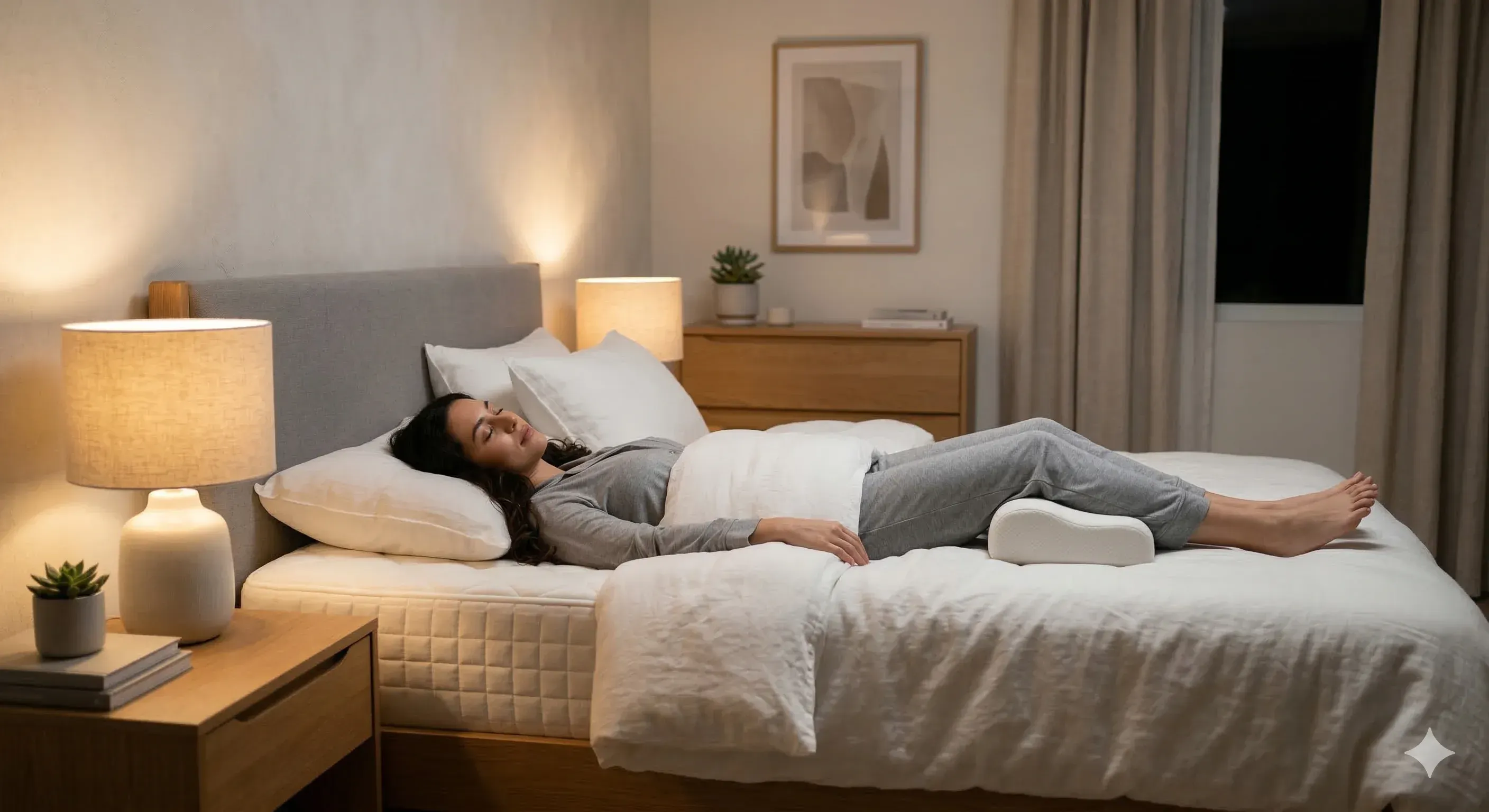
The best sleeping position for back pain is lying on your back with a pillow placed under your knees. This position distributes your body weight evenly across the widest possible surface area, eliminating uneven pressure on the lower back. The pillow under the knees helps maintain the spine's natural lumbar curve by slightly flexing the hips, reducing the muscle tension that causes lower back pain. Physiotherapists and orthopaedic specialists consistently recommend this position as the most effective sleeping posture for both preventing and relieving lower back pain.
Why Sleeping Position Affects Back Pain
To understand why sleeping position matters so much for back pain, it helps to know what the spine needs during sleep and what happens when it doesn't get it.
Spinal Alignment
Your spine has three natural curves: the cervical curve at the neck, the thoracic curve at the mid-back, and the lumbar curve at the lower back. These curves work together as a balanced system that distributes mechanical loads efficiently throughout the day. During sleep, maintaining these natural curves in a neutral position is essential. Any sleeping position that flattens, exaggerates, or twists these curves places the surrounding muscles, ligaments, and spinal discs under sustained tension for hours at a time, directly causing or worsening back pain.
Muscle Tension
Back muscles stretched or contracted in the same position for 7 to 8 hours develop significant tension and fatigue, similar to holding a static stretch for an extended period. This is why back pain from poor sleeping position typically feels worst in the first 30 to 60 minutes after waking and gradually eases as movement redistributes the accumulated tension. The right sleeping position allows back muscles to reach their fully relaxed resting length overnight rather than holding compensatory tension.
Pressure on the Lower Back
The lumbar spine, which bears the most load of any spinal region during both waking and sleeping, consists of the five vertebrae of the lower back. In poor sleeping positions, the lower back is often the point of greatest mechanical disadvantage, either unsupported and sagging (too-soft mattress, stomach sleeping) or compressed against a rigid surface (too-firm mattress). Both extremes increase intradiscal pressure and strain the facet joints that stabilise each vertebral level.
Mattress Support
Even the correct sleeping position cannot fully compensate for an inadequate mattress. A mattress that is too soft allows the hips to sink, pulling the lumbar spine out of alignment, regardless of position. A mattress that is too firm creates pressure points that force frequent position changes, fragmenting sleep and preventing the prolonged spinal decompression that sleep should provide. The combination of correct sleeping position and appropriate mattress support is more effective than either factor alone.
Best Sleeping Positions for Back Pain Relief
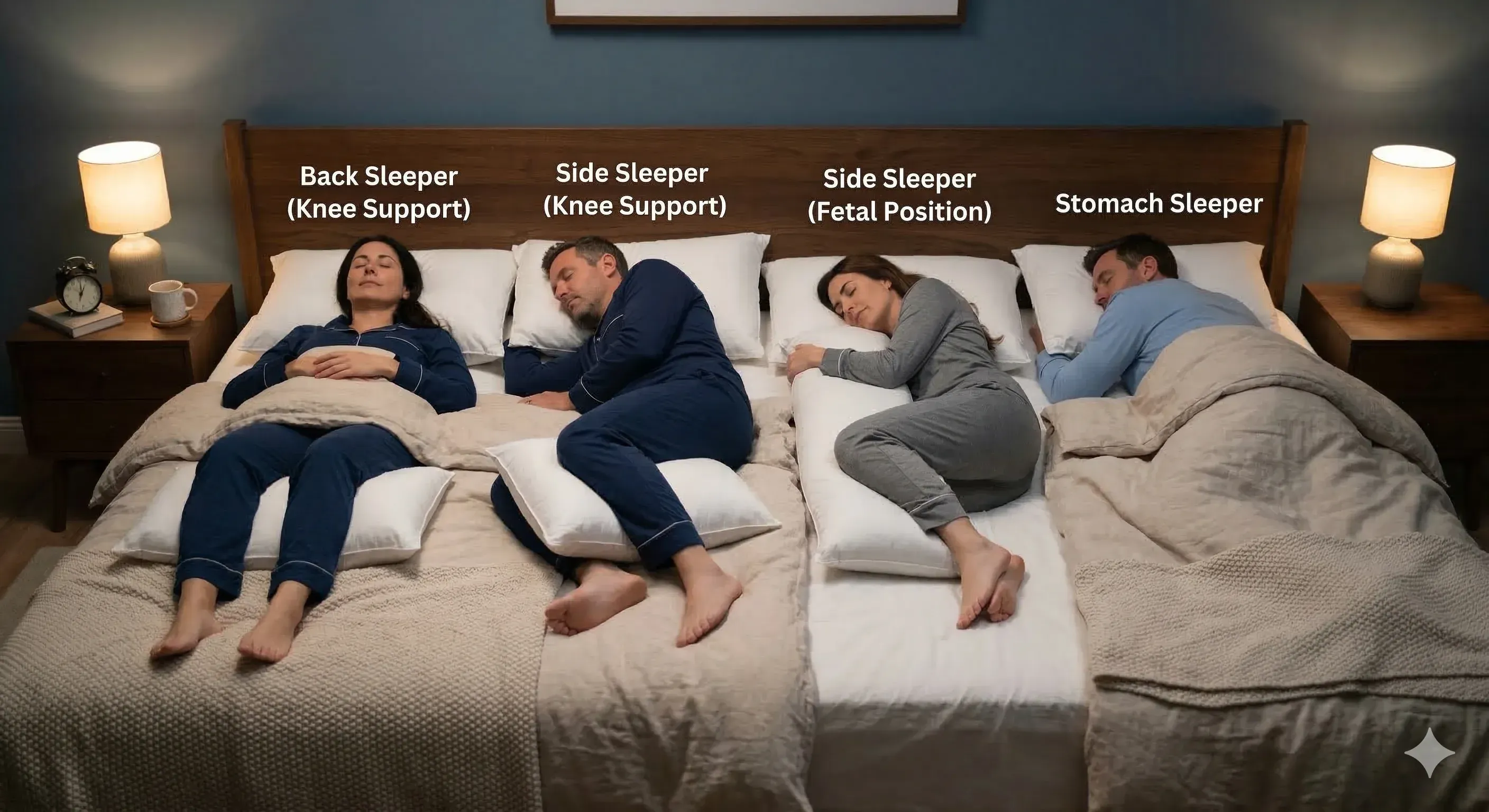
1. Sleeping on Your Back, Best Position Overall
Back sleeping is consistently rated the best sleeping position for back pain by orthopaedic specialists and sleep researchers nd for good reason. When you sleep flat on your back, your body weight distributes evenly across the largest possible contact surface shoulders, mid-back, hips, and legs all share the load. No single area of the spine bears disproportionate pressure.
The lumbar spine in back sleeping naturally maintains a slight inward curve, the normal lumbar lordosis. Placing a medium-firm pillow under your knees enhances this benefit by slightly flexing the hips, which flattens and relaxes the lower back further against the mattress surface. This single adjustment pillow under the knees is one of the most consistently recommended interventions for lower back pain during sleep.
For people with specific lumbar conditions, such as spinal stenosis, facet joint arthritis, or lumbar disc disease, the back sleeping position with knee support is often the only position that allows genuinely comfortable sleep because it places the lumbar spine in a neutral, decompressed state.
Best for: General lower back pain, lumbar disc problems, spinal stenosis, facet joint pain, post-surgical recovery.
2. Side Sleeping With Pillow Between Knees
Side sleeping is the most natural and common sleep position, and with the right pillow support, it is an excellent option for managing back pain. The key modification that makes side sleeping beneficial rather than harmful for back pain is a pillow placed firmly between the knees.
Without a knee pillow, side sleeping causes the top leg to drop forward across the lower leg, which rotates the pelvis and lower spine, creating twisting tension in the lumbar muscles and sacroiliac joints throughout the night. This twisting is a primary cause of lower back pain in side sleepers who sleep without knee support.
With a medium-firm pillow between the knees, the hips remain stacked level with each other, the pelvis stays neutral, and the lumbar spine maintains its natural alignment. The effect is a side sleeping position that supports rather than strains the lower back. Choose a pillow thick enough to keep the knees at the same height as the hips; typically, a standard or body pillow works well.
Best for: Side sleepers with lower back pain, sacroiliac joint pain, hip pain, and those who cannot transition to back sleeping.
3. Fetal Position for Herniated Disc
For people with a herniated or bulging lumbar disc, the fetal position, lying on the side with both knees drawn up toward the chest, can provide significant relief. Lumbar disc herniations cause pain because the displaced disc material presses on adjacent nerve roots. The fetal position opens the intervertebral spaces on the affected side by flexing the lumbar spine, reducing the compressive force on the bulging disc and relieving nerve pressure.
The fetal position is specifically beneficial for the type of back pain that worsens with standing, walking, and spinal extension, which are characteristics of disc herniation and spinal stenosis. It is less appropriate for facet joint pain or muscle strain, where spinal flexion may increase rather than reduce discomfort.
When using the fetal position, keep the knees drawn up comfortably, not pulled tightly to the chest, and place a pillow between the knees to prevent pelvic rotation. Alternate sides if possible to prevent one-sided muscle tension from developing over time.
Best for: Lumbar disc herniation, bulging disc, spinal stenosis, sciatica.
Worst Sleeping Positions for Back Pain
Sleeping on Your Stomach
Stomach sleeping is the worst position for back pain and one of the most common positions among people who suffer from it. When you sleep face down, the natural lumbar curve is exaggerated, and the lower back arches upward as the abdomen sinks into the mattress. This hyper-extended lumbar position places direct compressive load on the facet joints, strains the spinal ligaments, and creates sustained muscle tension along the entire length of the lower back.
Additionally, stomach sleepers must rotate their neck to one side to breathe, creating asymmetric cervical strain that refers tension through the upper back and shoulders. Over a full night, this combination of lumbar extension and neck rotation produces exactly the pattern of pain, lower back stiffness and neck soreness that stomach sleepers consistently report upon waking.
If you are a habitual stomach sleeper with back pain, transitioning to back or side sleeping is one of the single most impactful changes you can make. Place a body pillow beside you to prevent unconsciously rolling onto your stomach during sleep while you adapt to a new position.
Twisted Sleeping Positions
Any sleeping position in which the torso and pelvis face in different directions creates rotational strain on the lumbar spine and sacroiliac joints. Common examples include sleeping with one arm reaching overhead while the torso twists, sleeping with one leg draped over a partner or pillow in a way that rotates the pelvis, or transitioning between positions during sleep and getting stuck in an intermediate twisted posture.
The lumbar spine has very limited rotational capacity; its facet joints are oriented to allow forward and backwards bending rather than rotation. Sustained rotational positioning during sleep therefore rapidly creates joint and muscle tension, producing the characteristic dull, diffuse lower back pain many people experience upon waking.
Best Pillow Placement for Back Pain
Pillow placement is a simple, cost-free intervention that significantly improves the quality of sleep position for back pain sufferers. Here are the three most effective placements:
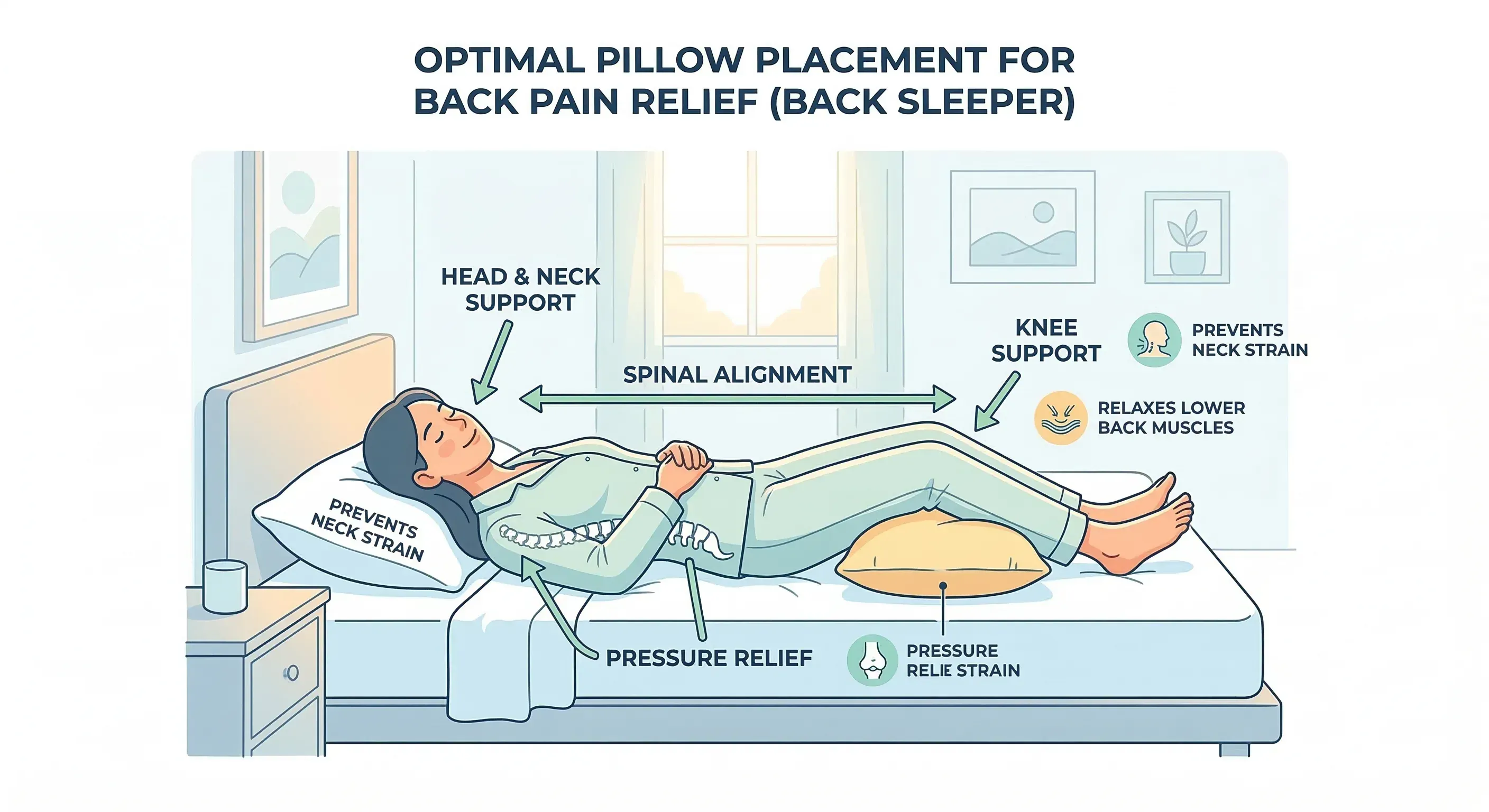
Pillow Under the Knees (Back Sleepers)
Placing a medium-firm pillow under both knees when sleeping on your back is the single most recommended pillow intervention for lower back pain. The elevation typically 10 to 15cm flexes the hips slightly, flattening the lumbar curve against the mattress and dramatically reducing intradiscal pressure in the lower back. Studies show that this position reduces lumbar muscle activity by up to 25% compared with flat-back sleeping without knee support.
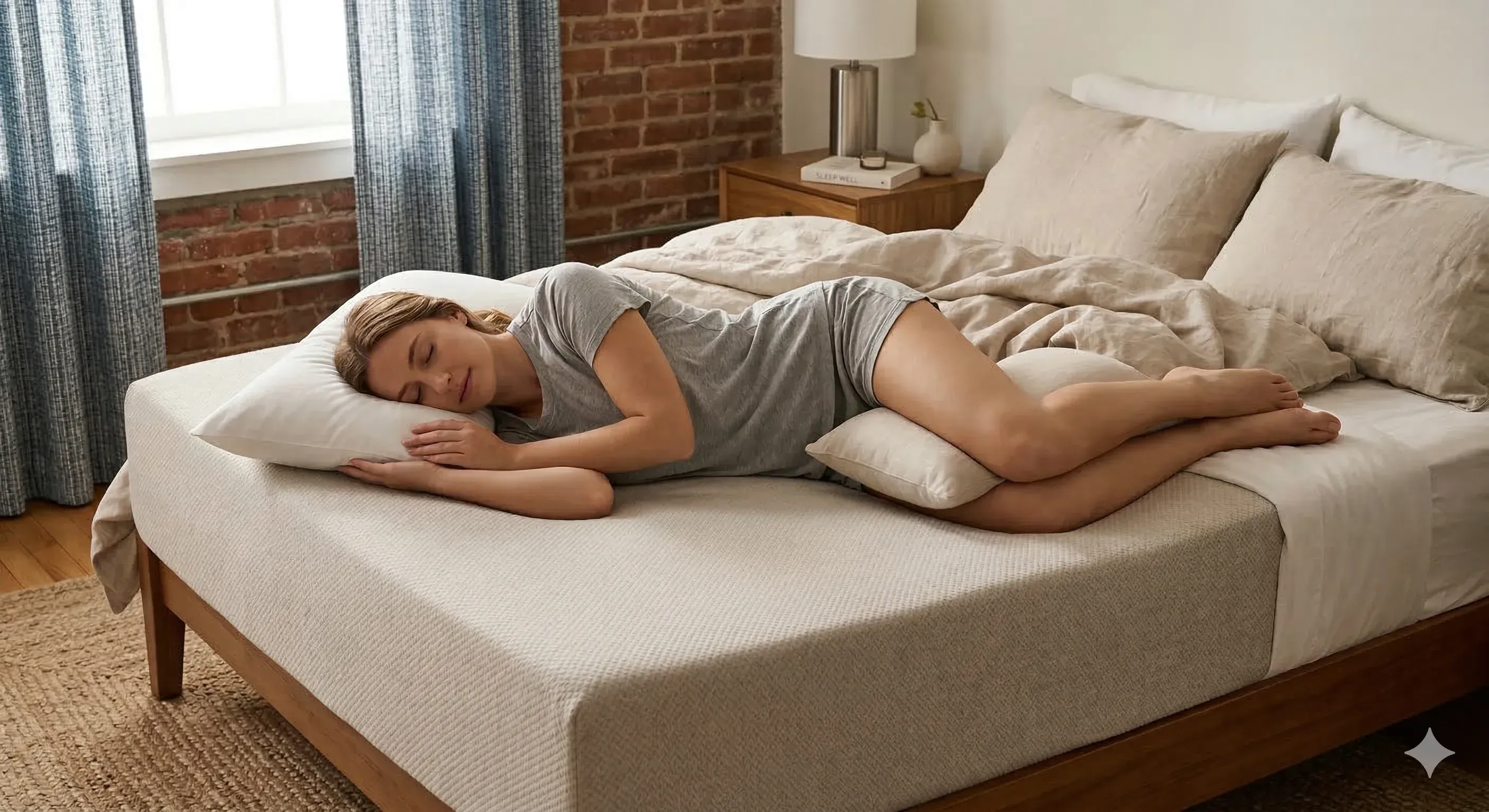
Pillow Between the Knees (Side Sleepers)
A pillow between the knees in side sleeping keeps the hips stacked level and prevents pelvic rotation, the primary cause of lower back pain in side sleepers. The pillow should be firm enough to maintain its height throughout the night. A body pillow running the full length of the torso is particularly effective as it also prevents unconscious forward rolling onto the stomach during sleep.
Small Pillow Under the Lower Back
For back sleepers with a pronounced lumbar curve where a gap exists between the lower back and the mattress surface, even in the correct position, a small rolled towel or thin pillow placed in the lumbar curve provides targeted support that fills this gap and prevents the lower back from hanging unsupported. This is particularly useful for people with lumbar hyperlordosis or muscle tension that prevents the lumbar curve from fully relaxing onto the mattress.
How Your Mattress Affects Back Pain
Your mattress is the foundation of your sleeping position, and no sleeping posture adjustment can fully compensate for a mattress that fails to support your spine correctly.
Firmness and Spinal Support: A mattress that is too soft allows the hips to sink deeper than the shoulders when sleeping on the back or side, creating a curved spinal position that strains the lower back throughout the night. A mattress that is too firm creates pressure points and prevents the natural lumbar curve from being maintained. Medium-firm mattresses, typically 5.5 to 7 on the firmness scale, provide the optimal balance for most back pain sufferers.
Pressure Relief: Adequate cushioning in the mattress comfort layer reduces pressure on the hips and shoulders, which can cause unconscious tossing and turning, thereby reducing the frequency of position changes that interrupt sleep and prevent sustained spinal decompression.
Sagging: A sagging mattress is one of the most common and overlooked causes of worsening back pain. Even a 1- to 2-inch sag in the centre of the mattress where the hips rest creates a hammock effect that misaligns the spine, regardless of sleeping position. If your mattress is 7 to 8 years old and your back pain has been gradually worsening, replacing it should be the first intervention you consider.
For a complete mattress guide for back pain, read our Best Mattress for Back Pain guide.
Best Mattress Firmness for Back Pain
Mattress firmness is the single most important mattress specification for back pain sufferers, and choosing correctly can make the difference between waking refreshed and waking in pain.
Research consistently identifies medium-firm mattresses in the 5.5-7 range on the firmness scale as the most effective for lower back pain relief across the widest range of sleeping positions and body types. A landmark study in The Lancet found that participants with chronic lower back pain who switched to medium-firm mattresses reported significantly less pain and disability than those on firm mattresses.
The reason medium-firm works best is the balance it achieves, soft enough to cushion the hips and relieve pressure points, but firm enough to keep the lumbar spine in its natural alignment rather than allowing the hips to sink and the lower back to bow. For side sleepers with back pain, the softer end of medium-firm (5.5 to 6) typically works best. For back sleepers with back pain, the firmer end (6 to 7) provides better lumbar support.
For detailed firmness guidance, read our comprehensive Mattress Firmness Guide: How to Choose the Perfect Firmness Level.
Stretching Exercises to Reduce Back Pain Before Bed
Performing gentle back stretches before sleep reduces muscle tension, improves spinal mobility, and decreases overnight pain. Perform each exercise slowly on a firm surface and stop if sharp pain occurs:
Knee-to-Chest Stretch
Lie flat on your back. Slowly draw one knee toward your chest, holding it with both hands for 20 to 30 seconds. Feel the stretch through the lower back and gluteal muscles. Repeat with the other leg, then draw both knees to the chest simultaneously. This stretch decompresses the lumbar facet joints and releases the lower back muscles that accumulate tension during the day. Perform 3 repetitions per side.
Cat-Cow Stretch
Begin on all fours with your hands under your shoulders and knees under your hips. Inhale as you drop your belly toward the floor and lift your head and tailbone (cow position). Exhale as you round your spine toward the ceiling, tucking your chin and pelvis (cat position). Move slowly and fluidly between the two positions for 10 full breath cycles. This stretch mobilises the entire lumbar and thoracic spine, increases synovial fluid circulation in the spinal joints, and relieves the muscular tension that worsens overnight back pain.
Pelvic Tilt
Lie flat on your back with knees bent and feet flat on the floor. Gently press your lower back into the floor by tightening your abdominal muscles and tilting your pelvis upward slightly. Hold for 5 seconds, then release. Repeat 10 times. This exercise activates the deep abdominal stabilising muscles that support the lumbar spine during sleep and reduces the lumbar muscle tension that causes morning stiffness.
Common Sleeping Mistakes That Cause Back Pain
- Wrong Pillow Height: A head pillow that is too high or too low creates neck misalignment, which radiates tension through the upper back and eventually the lower back. Your pillow should fill the gap between your ear and shoulder when side sleeping, or maintain a slightly neutral chin position when back sleeping.
- Sleeping on the Stomach Without Realising It: Many people fall asleep in back or side position but unconsciously roll onto their stomach during the night. If you consistently wake with lower back pain and do not remember rolling over, a body pillow placed along your front when side sleeping prevents stomach rolling during sleep.
- Poor Mattress Support: Continuing to sleep on a sagging or overly soft mattress despite worsening back pain is the most common and correctable sleeping mistake. A mattress that fails to support spinal alignment makes every other intervention significantly less effective.
- Sitting in Bed Before Sleep: Sitting propped up in bed watching TV or using a phone with the back unsupported rounds the lumbar spine into flexion for extended periods before sleep, pre-loading back muscle tension that persists into the sleep period and worsens overnight pain.
- Sudden Position Changes: Rolling quickly from one position to another during sleep or when waking can strain already sensitised lumbar muscles. Learn to log-roll, turning the entire body as a single unit when changing positions, particularly during acute back pain flares.
Expert Tips to Sleep Comfortably With Back Pain
- Use a Supportive Mattress: A medium-firm mattress matched to your sleeping position is the most impactful single investment for back pain during sleep. If replacing the mattress is not immediately possible, a 5-7cm memory foam topper can improve surface pressure relief on a too-firm mattress.
- Maintain Your Sleep Posture Consistently: The benefits of correct sleeping position accumulate over multiple nights of consistent practice. Set up your pillow system before sleep and consciously return to the correct position each time you wake during the night.
- Apply Heat Before Bed: A heat pack applied to the lower back for 15 to 20 minutes before sleep relaxes the chronic muscle tension that worsens overnight. Heat increases blood flow to the area, reduces muscle spasm, and makes the muscles more responsive to the decompression provided by the correct sleeping position.
- Maintain a Consistent Sleep Schedule: Irregular sleep patterns increase systemic inflammation and pain sensitivity. A consistent bedtime and wake time support both sleep quality and pain management by regulating the circadian hormonal cycle that modulates pain perception.
- Consider Your Entire Sleep Setup: Mattress, pillow, sleeping position, and pre-bed routine work together as a system. Optimising all four factors simultaneously yields significantly better results than changing any single element. For guidance on mattress selection, see our Best Mattress for Side Sleepers guide and our Best Mattress for Back Pain guide.
When to See a Doctor for Back Pain
While most back pain improves with better sleep position, a better mattress, and stretching, some conditions require professional medical assessment. See a doctor promptly if you experience:
- Back pain that radiates down one or both legs, particularly past the knee
- Numbness, tingling, or weakness in the legs or feet
- Back pain following a fall, accident, or injury
- Pain that is constant and does not improve with position changes
- Back pain accompanied by bladder or bowel changes
- Severe pain that wakes you from sleep and does not settle
- Back pain in anyone over 50 with no previous history
These symptoms may indicate nerve compression, spinal stenosis, fracture, or other conditions requiring medical diagnosis and treatment beyond sleep position adjustment alone.
Conclusion
The best sleeping position for back pain is back sleeping with a pillow under the knees, consistently the most effective posture for spinal decompression and relaxation of the lower back muscles during sleep. Side sleeping with a firm pillow between the knees is an excellent alternative for those who cannot transition to back sleeping. Avoid sleeping on your stomach entirely; it is the single most damaging position for your lower back.
Combine the right sleeping position with a medium-firm mattress, correct pillow placement, pre-bed stretching, and consistent sleep timing, and most back pain sufferers will notice significant overnight improvement within 1 to 2 weeks. Your spine deserves neutral alignment and full muscle relaxation every night. Give it the right conditions, and it will repay you with pain-free mornings.
Also read: Best Mattress for Back Pain Complete Relief Guide
Further reading: Best Mattress for Side Sleepers Pressure Relief Guide
See also: Best Sleeping Position for Shoulder Pain Expert Guide