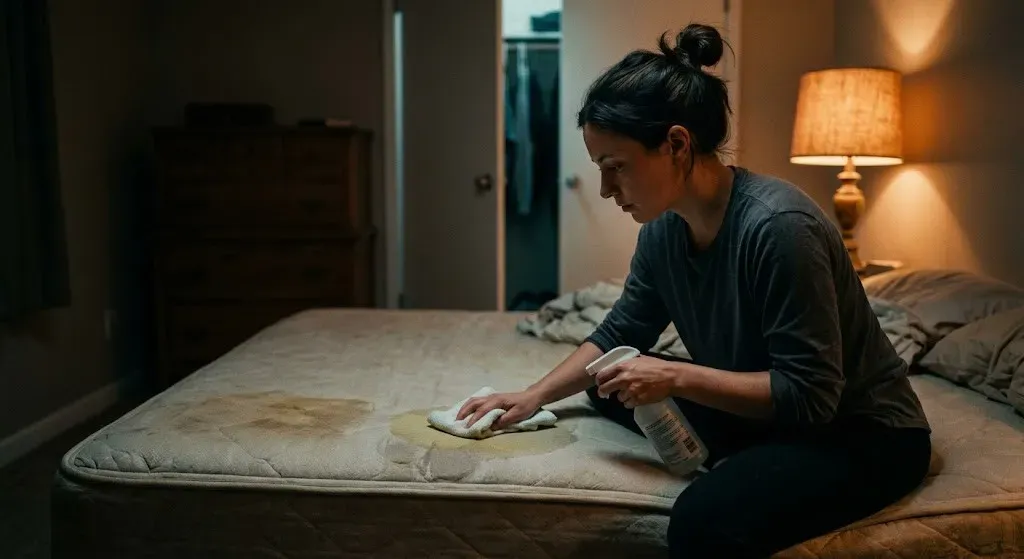
How to Remove Old Urine Stains From a Mattress
Old urine stains on a mattress are one of the most frustrating things to deal with. If you are trying to remove old urine stains from a mattress that has been sitting for days, weeks, or even longer, you are in the right place. The good news is that even the most stubborn yellow stains can be treated successfully at home.
You need to use the right method. And that is exactly what this guide covers.
Quick Links
- Why Old Urine Stains Are Harder to Remove
- What You Will Need
- Method One: Hydrogen Peroxide Solution
- Method Two: Enzyme Cleaner Approach
- Tips for Very Stubborn Stains
- Frequently Asked Questions
Why Old Urine Stains Are Harder to Remove
Fresh urine is mostly water. It comes out relatively easily. But as urine dries, water evaporates, leaving behind concentrated compounds, including uric acid crystals, ammonia, and urobilin. Urobilin is the yellow pigment responsible for that tell-tale staining you see on the mattress surface.
These compounds bond with the mattress fabric tightly over time. The longer they sit, the stronger that bond becomes. This is why a stain that has been there for two weeks is much harder to shift than one that happened yesterday. Uric acid is a compound produced when the body breaks down purines, and when it crystallizes on fabric, it becomes extremely difficult to dissolve with water alone. This is exactly why old urine stains resist basic cleaning methods.
Plain water and basic soap will not cut through this. You need cleaning agents that actively break down uric acid crystals. Thankfully, two of the best options for doing this are inexpensive and easy to find.
What You Will Need
- 3% hydrogen peroxide (available at any pharmacy)
- Baking soda
- Liquid dish soap
- Distilled white vinegar
- Cold water
- Clean white towels
- Spray bottle
- Vacuum cleaner
- Enzyme cleaner (for pet urine or very severe stains)
Method One: Hydrogen Peroxide Solution
This is the most effective method for removing yellow urine stains that have set in and dried. Hydrogen peroxide acts as a mild bleaching agent, breaking down yellow pigments without damaging most mattress fabrics.
Start by lightly misting the old stain with cold water—just enough to soften the surface slightly. Then mix the cup of 3% hydrogen peroxide, three tablespoons of baking soda, and a few drops of dish soap in a spray bottle.
Spray this directly onto the stain. Be generous. You need it to penetrate the stain's full depth, not just sit on the surface. Then leave it completely alone. Do not blot, do not rub. Let it air-dry completely.
As it dries, the baking soda will form a white powdery crust over the treated area. Once it is fully dry, vacuum it all away. Check the stain under good lighting. For most old stains, you will see a dramatic improvement after just one round.
If a faint mark remains, repeat the process. Very old stains often need two or three rounds before they disappear entirely. Keep going and do not give up after one attempt.
One important note: hydrogen peroxide can lighten some mattress fabrics. Always test a small amount in a hidden spot before applying it to a visible stain area.
Method Two: Enzyme Cleaner Approach
For very old stains or those caused by pet urine, an enzyme cleaner is often the most effective option. Enzyme cleaners work differently from other cleaning solutions. They contain enzymes that break down organic compounds in urine at the molecular level.
This means they do not just lift the visible stain. They also destroy the odor-causing compounds that other methods sometimes leave behind. According to the ASPCA, enzyme-based cleaners are among the most recommended solutions for removing pet urine from soft surfaces, including mattresses and upholstery.
To use an enzyme cleaner on an old stain, first lightly dampen the area with cold water. Then apply the enzyme cleaner generously and leave it for at least 30 minutes. For very old stains, leave it for a full hour. Blot up the liquid with clean towels, then cover the area with baking soda and leave it overnight. Vacuum in the morning.
Repeat this process if needed. Old pet urine stains in particular may need two or three rounds of enzyme cleaner treatment before the stain and smell are fully gone.
Tips for Very Stubborn Old Stains
- Combine both methods. Use the enzyme cleaner first to break down the uric acid crystals, then follow up with the hydrogen peroxide solution to lift the remaining yellow pigment.
- Be patient. Old stains did not form overnight, and they will not disappear overnight. Multiple rounds of treatment are completely normal.
- Always use cold water. Hot water makes old urine stains even more permanent by bonding the proteins deeper into the fabric.
- Allow full drying time between each round of treatment before inspecting results.
Still Dealing With the Smell After Cleaning the Stain?
It is very common for the smell to outlast the visible stain. Odor compounds soak deeper than the stain itself. If you have lifted the stain but the smell persists, visit our dedicated guide on removing urine odor from a mattress for targeted odor removal methods.
If you are dealing specifically with old pet urine, our guides on how to get cat pee out of a mattress and how to get dog pee out of a mattress will give you the right approach for those cases.
For a complete guide covering every urine situation, including fresh accidents, dried stains, odor removal, and prevention, visit our full pillar article: How to Get Urine Out of a Mattress: The Complete Guide.