
10 Signs You Need a New Mattress for Better Sleep
Your mattress is the single most used piece of furniture in your home. You spend approximately one-third of your life lying on it, and yet most people pay far less attention to its condition than to their sofa, car, or phone. The result is that millions of people are sleeping on mattresses that have long since passed their useful lifespan, silently sabotaging their sleep quality, back health, and daily energy levels without ever connecting the problem to the bed beneath them.
The challenge is that mattress deterioration is gradual. Unlike a broken chair or a cracked phone screen, a worn-out mattress does not announce itself dramatically. It declines slowly, week by week, until the support it provides is a fraction of what it was when new. By the time most people notice the problem, they have already been sleeping on an inadequate mattress for years.
Recognizing the signs you need a new mattress early can prevent months or years of poor sleep, morning back pain, fatigue, and worsening allergy symptoms. In this complete guide, we explain ten clear warning signs that your mattress needs replacing, the health consequences of sleeping on an old mattress for too long, how mattress lifespan varies by material, and how to choose the right replacement when the time comes.
Quick Answer: How Do You Know When You Need a New Mattress?
Most mattresses should be replaced every 7 to 10 years, depending on the material and quality. The clearest signs you need a new mattress include visible sagging or lumps in the sleeping surface, waking up with back or neck pain that was not present before, tossing and turning throughout the night, sleeping noticeably better in hotels or other beds, worsening allergy symptoms, and a general feeling that your sleep quality has declined despite nothing else changing in your lifestyle or routine. If two or more of these apply to you, replacing your mattress should be your priority.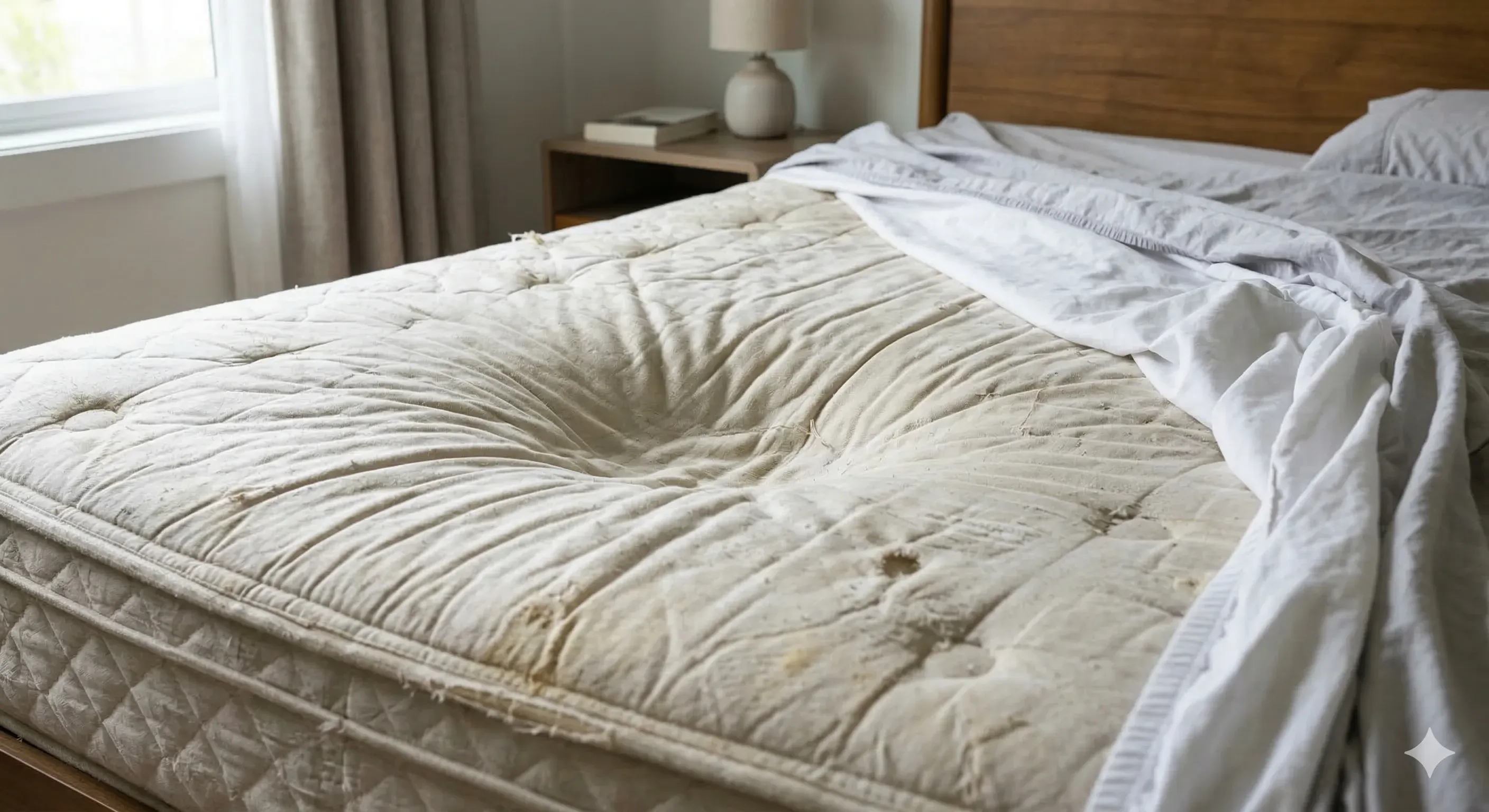
How Long Does a Mattress Usually Last?
Mattress lifespan varies significantly depending on the material, construction quality, sleeper weight, and maintenance. Here is a complete breakdown by mattress type:
| Mattress Type | Average Lifespan | Key Degradation Factor |
|---|---|---|
| Memory Foam | 8 to 10 years | Body impressions and heat-related softening |
| Latex | 10 to 15 years | Gradual resilience loss, slower than foam |
| Innerspring | 6 to 8 years | Coil fatigue, sagging, and noise development |
| Hybrid | 8 to 10 years | Foam layer compression and coil fatigue |
| Budget Foam | 4 to 6 years | Rapid compression set due to low-density foam |
These are averages and represent the point at which most mattresses no longer provide adequate support and comfort for healthy sleep. The experience varies based on usage. A mattress used by a single lightweight sleeper may remain comfortable beyond its average lifespan. A mattress used nightly by two adults, particularly those over 80kg each, may degrade significantly faster than the average.
Body weight is one of the most important factors in mattress longevity. Heavier individuals compress foam and coil systems more deeply with each sleep cycle, accelerating compression set and coil fatigue that gradually destroy a mattress's support profile. If you are above average body weight, reduce the expected mattress lifespan estimates above by 1 to 2 years as a practical guideline.
Maintenance also plays a critical role. Mattresses that are never rotated develop concentrated wear patterns that significantly shorten their effective lifespan. Mattresses without protectors absorb moisture and body oils that degrade foam and coil materials from within. A well-maintained mattress consistently outperforms a neglected one of identical quality.
10 Signs You Need a New Mattress
The following signs are the most reliable indicators that your mattress has passed its useful lifespan and is actively harming rather than supporting your sleep. Most people experience several of these simultaneously before taking action. If three or more of these apply to you, the evidence for replacement is strong. If five or more apply, replacement is overdue.
1. Your Mattress Is More Than 8 Years Old
Age alone is one of the most reliable signs you need a new mattress, even if the mattress appears superficially intact. After 7 to 8 years of nightly use, most mattresses, even those that were originally high quality, have experienced significant internal degradation. Foam layers have compressed and lost their resilience. Coil systems have fatigued and lost their original tension. The support profile that the mattress provided when new has changed substantially, even if the surface does not appear visibly damaged.
A common mistake is judging mattress condition by appearance alone. A mattress can look perfectly flat and unmarked on the surface while its internal foam layers have permanently compressed to a fraction of their original density. If your mattress is over 8 years old, treat it as a candidate for replacement, regardless of how it looks on the outside.

2. You Wake Up With Back or Neck Pain
Waking up with back or neck pain that eases within 30 to 60 minutes of getting up and moving is one of the clearest signs you need a new mattress. This pattern, pain upon waking that resolves during the day, is the signature of mattress-related spinal misalignment rather than a chronic medical condition. A worn mattress no longer maintains the spinal curves in their natural neutral positions during sleep, causing the surrounding muscles, ligaments, and spinal discs to remain under tension and compression throughout the night.
If the back or neck pain was not present before you got your current mattress, or if it has gradually developed and worsened over recent years, the mattress is almost certainly a primary contributing factor. For guidance on mattresses specifically for back pain, read our Best Mattress for Back Pain: Complete Buying Guide for Pain-Free Sleep.
3. Visible Sagging or Lumps
Visible sagging is the most obvious sign you need a new mattress, and it is one that many people continue to tolerate for years longer than they should. Sagging typically develops in the areas of highest regular contact, most commonly under the hips and shoulders of the primary sleeper. Even a 2 to 3cm sag creates a hammock effect that pulls the spine out of alignment throughout the night, directly causing the lower back pain and stiffness that mattress-related sagging is notorious for producing.
You can check for sagging by placing a straight object, such as a broom handle, across the mattress surface. Any visible dip or curve beneath the straight edge is sagging that exceeds acceptable levels. Lumps and uneven areas indicate broken-down foam layers or damaged coil systems that cannot be repaired and signal the need for immediate replacement.
4. You Toss and Turn All Night
Frequent position changes during sleep are often a sign that your body is unconsciously seeking a more comfortable surface. When a mattress no longer provides adequate pressure relief, the body responds to accumulated pressure at the shoulders, hips, and lower back by initiating position changes to redistribute the load. These movements, even when they do not fully wake you, fragment sleep architecture and prevent the deep slow-wave sleep that is most restorative.
If you consistently wake feeling unrested despite spending 7 to 9 hours in bed, or if your partner reports that you move significantly more than you used to, insufficient mattress pressure relief is a highly likely cause. A mattress that lets you sleep through the night without forced position changes is one of the most impactful sleep improvements available.
5. You Sleep Better in Hotels or Other Beds
One of the most telling signs you need a new mattress is consistently sleeping better away from home than in your own bed. If you notice that you wake more refreshed after sleeping in a hotel, a guest room, or even on a sofa, and the only variable is the mattress or sleeping surface, the conclusion is straightforward: your mattress is the problem.
Many people dismiss this comparison, attributing better sleep at hotels to novelty or relaxation. While those factors play a role, they do not explain a consistent pattern of better sleep across multiple locations and occasions. If your best sleep consistently happens away from home, your mattress deserves serious scrutiny.
6. Your Mattress Makes Noise
A mattress that creaks, squeaks, or makes noise when you move is almost always an innerspring or hybrid mattress with fatigued or damaged coil springs. New innerspring and hybrid mattresses are silent under movement. The development of noise indicates that individual coils have broken or lost their tension, producing metal-on-metal contact or spring compression sounds during movement.
A noisy mattress is not merely an annoyance. The coil fatigue that causes the noise also indicates reduced support capacity across the affected areas. Coils that have fatigued enough to make noise are no longer providing the spinal support they were designed to deliver. Noise from a spring mattress is a reliable indicator that its structural integrity has been compromised.
7. Allergy Symptoms Are Getting Worse
Over time, mattresses accumulate significant quantities of dust mites, mould spores, dead skin cells, and other allergens within their layers. Dust mites, the primary allergen concern in mattresses, feed on human skin cells and thrive in the warm, humid environment that a regularly used mattress provides. A mattress used for 8 or more years can contain millions of dust mites and their waste products throughout its foam and fabric layers.
If you experience worsening symptoms of rhinitis, asthma, eczema, or general allergy symptoms that worsen in the morning or in the bedroom, your mattress is a likely source of allergens. Washing bedding frequently and using a quality mattress protector reduces the accumulation rate, but does not eliminate the allergens already present in an older mattress. Replacement is the only complete solution for a heavily allergen-loaded mattress.
8. Your Mattress Feels Uncomfortable
This sign sounds obvious, but it is one that many people rationalize away for years. If your mattress regularly feels uncomfortable when you lie down, if you notice its surface quality when trying to fall asleep, and if you find yourself adjusting and readjusting your position to find comfort, your mattress has failed in its primary function.
Discomfort indicates that either the comfort layers have broken down and no longer provide adequate cushioning, the mattress firmness is no longer appropriate for your body or sleeping position, or both. Neither of these conditions improves with time. A mattress that is uncomfortable now will be more uncomfortable in six months.
9. You Notice Body Impressions
Body impressions, the permanent indentations left in the mattress surface by the outline of the body, are a sign of foam compression set that cannot be reversed. Unlike temporary surface softening that recovers after the sleeper gets up, body impressions remain visible when the mattress is unloaded. They indicate that the foam has permanently lost its cellular structure in the areas of the highest regular pressure.
Body impressions greater than 1.5cm in depth indicate significant loss of support in areas where the body needs it most. Many mattress warranties cover body impressions above 2 to 4cm, depending on the manufacturer. If your mattress shows visible body impressions, check your warranty and begin evaluating replacement options regardless of the warranty outcome.
10. Your Sleep Quality Has Decreased
A gradual, unexplained decline in sleep quality over months or years, without a clear lifestyle, health, or environmental cause, is one of the subtlest but most significant signs you need a new mattress. If you are spending the same amount of time in bed but waking feeling less rested than you used to, if daytime fatigue has increased, if your concentration and mood have declined, and nothing else in your life has obviously changed, your mattress may be the silent culprit.
Mattress deterioration affects sleep quality gradually enough that many people attribute the decline to aging, work stress, or other factors without ever considering the mattress. The practical test is simple: if your sleep quality was better several years ago when your mattress was newer, and nothing else has significantly changed, the mattress decline and the sleep quality decline are almost certainly related.
Health Problems Caused by an Old Mattress
Sleeping on a worn-out mattress is not merely uncomfortable. It has documented health consequences that compound over time:
Back Pain: This is the most common and most directly documented health consequence of mattress deterioration. A mattress that no longer provides adequate lumbar support allows the spine to sag out of its natural alignment during sleep, creating sustained pressure on the spinal discs and surrounding muscles for 7 to 8 hours every night. Over weeks and months, this sustained misalignment produces chronic lower back pain, one of the leading causes of reduced quality of life and lost productivity worldwide.
Poor Sleep Quality and Fatigue: A mattress that causes pressure discomfort, forces frequent position changes, or no longer maintains comfortable spinal alignment directly reduces sleep continuity and depth. The result is reduced time spent in the deep slow-wave and REM sleep stages, which provide physical and mental restoration. Chronic poor sleep quality produces cumulative fatigue that affects cognitive performance, emotional regulation, immune function, and metabolic health in ways that reach far beyond simple tiredness.
Muscle Stiffness: Sleeping on an unevenly supported mattress causes muscles to maintain compensatory tension throughout the night, preventing the complete relaxation that healthy sleep should provide. The result is the characteristic morning stiffness, particularly in the lower back, neck, and shoulders, that eases only after 30 to 60 minutes of movement. This morning stiffness is the body's response to a night of sustained muscular compensation for inadequate mattress support.
Allergy-Related Health Effects: Accumulation of allergens in old mattresses, particularly dust mites and mould, can trigger or worsen rhinitis, asthma, eczema, and general immune reactivity. For allergy and asthma sufferers, an allergen-loaded mattress represents a nightly 8-hour exposure to allergens that no amount of antihistamine medication can fully compensate for.
How Often Should You Replace a Mattress?
The general recommendation for most mattress types is replacement every 7 to 10 years, but several factors determine where your specific situation falls within that range:
Mattress Type: As the lifespan table above shows, latex mattresses last significantly longer than innerspring models. If you have a quality latex mattress and it still feels supportive and comfortable at year 10, there is no urgency to replace it. If you have a budget inner spring at year 6 and it is showing signs of wear, replacement is likely appropriate.
Lifestyle Factors: Active individuals, athletes, and those who experience significant physical stress during the day place higher recovery demands on their sleep environment. The mattress must provide more consistent, high-quality support for these individuals, making earlier replacement appropriate when degradation begins.
Body Weight and Usage: As discussed, heavier sleepers and couples sharing a mattress experience accelerated wear and tear. Two adults sharing a mattress should typically plan to replace it at the shorter end of the lifespan range for their mattress type.
Tips for Extending the Life of Your Mattress
While replacement is inevitable, proper maintenance can significantly extend the period during which your mattress provides adequate comfort and support:
- Rotate Your Mattress Regularly: Rotate your mattress 180 degrees every 3 to 6 months to distribute wear evenly across the sleeping surface. This prevents the development of a concentrated body impression, which accelerates the loss of localized support. Most modern mattresses should not be flipped as they have a designated top side, but rotation alone meaningfully extends lifespan.
- Use a Quality Mattress Protector: A waterproof mattress protector prevents moisture, body oils, and allergens from penetrating the mattress materials. Moisture accelerates foam degradation and creates the conditions for mould and dust mite proliferation. A protector that is washed every 2 to 4 weeks helps maintain mattress hygiene and significantly extends its lifespan.
- Use a Proper Bed Base: A mattress performs correctly only on a bed base designed to support it. Memory foam and latex mattresses require solid or slatted bases with slat gaps no wider than 7cm. Using these mattresses on old bases with broken or widely spaced slats accelerates uneven compression and sagging.
- Clean Your Mattress Periodically: Vacuum the surface of the mattress every 2 to 3 months to remove surface dust, skin cells, and debris. Spot-clean any stains immediately to prevent moisture from penetrating the foam layers. Air the mattress periodically by removing bedding and allowing airflow across the surface.
How to Choose a Replacement Mattress
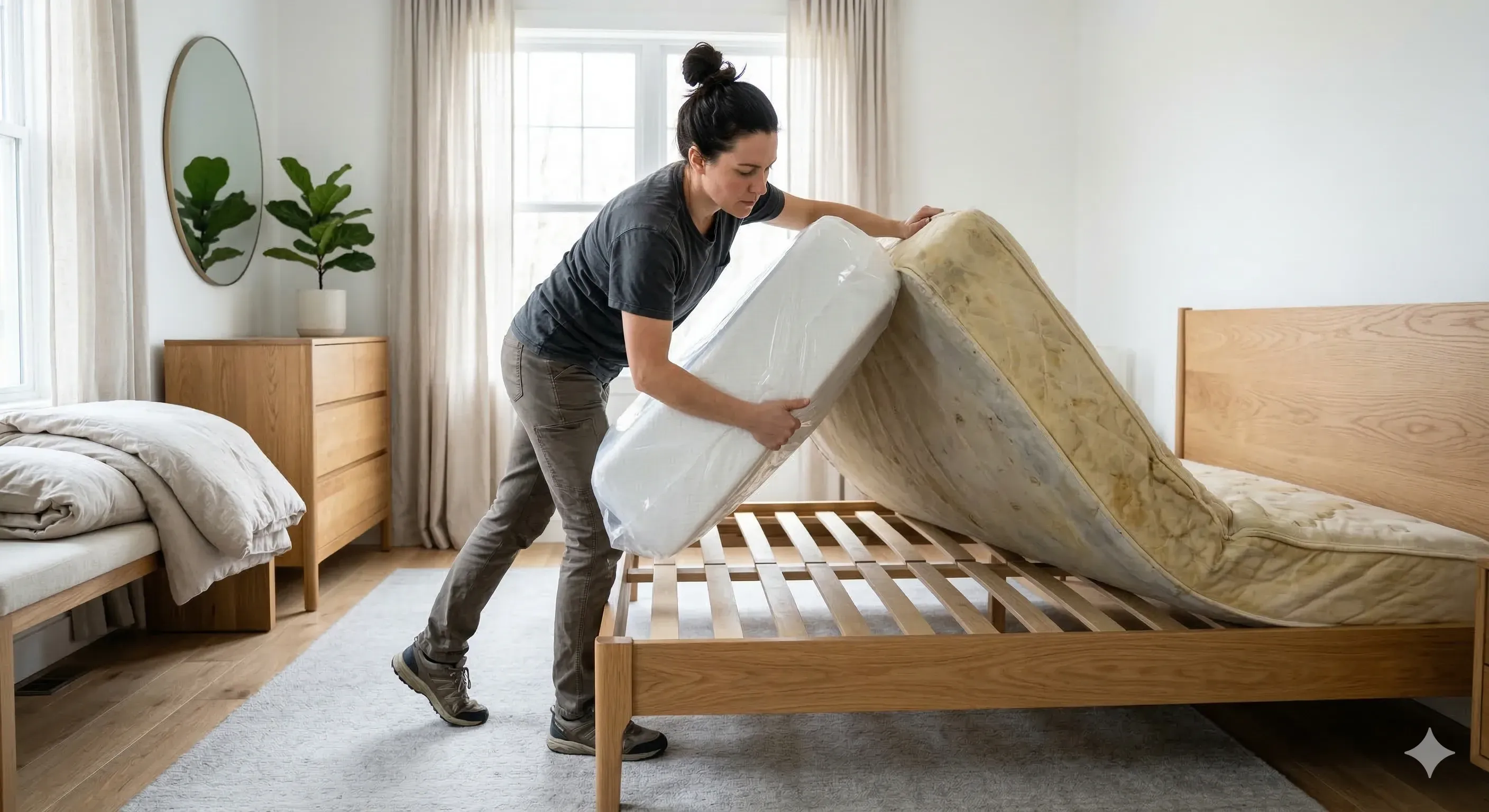
Once you have identified the signs that replacement is necessary, choosing the right replacement is the next critical step. Three factors determine the right mattress for your needs:
Mattress Firmness: Firmness is the most important specification for matching a mattress to your body and sleeping position. Medium-firm mattresses in the 5.5 to 7 range on the firmness scale suit the widest range of sleepers, but your specific sleeping position and body weight further refine this. Side sleepers need softer options (4 to 6) for shoulder and hip pressure relief. Back sleepers do best on medium-firm (5.5 to 7). Stomach sleepers need firmer support (6.5 to 8) to prevent hip sinking and lumbar hyperextension. Read our complete Mattress Firmness Guide: How to Choose the Perfect Firmness Level for detailed guidance.
Sleeping Position: Your primary sleeping position determines the firmness range you need, the material that best supports your pressure-relief and support needs, and the thickness of the comfort layers that will work best for you. Never choose a mattress without first identifying your sleeping position and using it as your primary filter.
Mattress Material: The material determines your mattress's feel, cooling performance, durability, and price. Memory foam provides the deepest pressure relief and motion isolation. Latex provides natural cooling, responsive support, and superior longevity. The hybrid combines foam comfort with coil support for a balanced performance across all categories. For a complete material comparison, read our Memory Foam vs Latex Mattress: Which One Is Better for Sleep?
Sleep Trial: Always purchase a replacement mattress with a minimum 100-night sleep trial. Mattress firmness and comfort cannot be accurately assessed in a showroom environment. The only reliable test is sleeping on it in your own home in your natural position for several weeks. Any reputable mattress brand will offer this, and you should not purchase from one that does not.
Conclusion
The signs you need a new mattress are often hiding in plain sight: morning back pain, restless nights, visible sagging, worsening allergies, and the nagging feeling that you sleep better everywhere except your own bed. Most people ignore these signs for years, attributing the symptoms to other causes while continuing to sleep on a mattress that actively harms their health and sleep quality.
A quality mattress is not a luxury expense. It is a direct investment in one-third of your life and in the health, energy, and cognitive function that proper sleep provides for the other two-thirds. If three or more of the signs in this guide apply to you, the time to replace your mattress is now. Your sleep, your back, and your daily energy levels will reflect the improvement within the first few weeks.