
Can a Mattress Cause Back Pain?
You wake up every morning with a stiff, aching lower back. You stretch, move around, drink your chai, and by mid-morning, the pain eases enough to function. You assume it is your posture, your desk job, your age, or simply one of those things you have to live with. It does not occur to you to look at the surface you spent the last 7 to 8 hours lying on.
Yet the answer to the question, "Can a mattress cause back pain is an unambiguous yes. A mattress that is too soft, too firm, or worn beyond its useful lifespan forces the spine into misaligned positions for hours at a time every single night. The resulting strain on the spinal muscles, ligaments, and discs produces exactly the pattern of morning back stiffness and pain that gradually eases during the day as movement redistributes the accumulated tension.
In this complete guide, we explain exactly how your mattress affects your spine during sleep, describe the clear signs that your mattress is the source of your back pain, cover the specific mattress problems that cause spinal damage, and help you identify the right mattress solution for your body and sleeping position. If you wake up with back pain every morning, your mattress deserves serious investigation before anything else.
How Your Mattress Affects Your Spine
To understand how a mattress can cause back pain, it is important first to understand what the spine needs during sleep and why the mattress is so central to providing it.
Natural Spinal Curve: The spine has three natural curves, the cervical inward curve at the neck, the thoracic outward curve at the mid-back, and the lumbar inward curve at the lower back. These curves work together as a balanced system that distributes mechanical forces efficiently throughout the day. During sleep, these curves need to be maintained in their natural positions. Any sustained deviation from natural spinal alignment, whether the lumbar curve is flattened, exaggerated, or laterally tilted, creates prolonged tension in the muscles, ligaments, and intervertebral discs that support and connect the vertebrae.
Importance of Support During Sleep: The body spends 7 to 9 hours in contact with the mattress every night. During this time, the mattress is the only structural support the spine receives. Unlike during waking hours,s when active muscle engagement and positional changes continuously redistribute spinal load, during sleep, the body relies entirely on the mattress to maintain the positioning that allows the spinal muscles to relax completely. A mattress that fails to provide this support does not give the spine the rest it needs. Instead, the back muscles maintain low-level compensatory tension throughout the night, producing the fatigue and stiffness that characterise mattress-related morning back pain.
How Poor Mattresses Affect Posture: A poor mattress creates spinal misalignment that the body adapts to over time. When the lumbar spine consistently sags into a mattress that is too soft, the surrounding muscles and ligaments gradually accommodate this distorted position. When a mattress is too firm, the inability of the hips and shoulders to sink into the surface creates lateral spinal curvature in side sleeping that the body similarly adapts to. Both forms of chronic misalignment gradually change the resting muscle tension patterns, contributing to daytime posture problems that persist beyond the bed itself.

Signs Your Mattress May Be Causing Back Pain
The pattern of mattress-related back pain is distinctive and recognisable once you know what to look for. These are the clearest signs that your mattress is the source of your back pain:
Waking Up With Stiffness: Morning back stiffness that is present from the moment you get out of bed is the most classic and reliable sign of mattress-related back pain. This stiffness reflects the accumulated muscular tension from a night of compensating for inadequate mattress support. It is specifically a morning phenomenon because the tension builds progressively during sleep and reaches its maximum upon waking.
Pain Improves During the Day: The single most diagnostic feature of mattress-related back pain is that it gradually eases over 30 to 60 minutes of morning movement and typically resolves or significantly improves by midday. This pattern distinguishes mattress-related pain from other causes of back pain. Movement redistributes accumulated tension, restores circulation to compressed tissues, and gradually resolves the stiffness caused by sleeping on an inadequate surface. If your back pain follows this exact pattern, your mattress is almost certainly a primary contributor.
Visible Mattress Sagging: A mattress that visibly sags, either throughout its centre or in the specific areas where you sleep, can no longer maintain spinal alignment, regardless of its original quality or your sleeping position. Even a 2 to 3cm body impression creates a hammock effect that pulls the lumbar spine into sustained flexion or lateral deviation throughout the night. If you can see or feel a dip in your mattress surface, it is actively causing or worsening your back pain.
Sleeping Better in Other Beds: Consistently waking without back pain in hotels, guest bedrooms, or other sleeping environments is perhaps the most definitive sign that your home mattress is the problem. When the only variable that changes is the mattress,s and your back pain resolves, the conclusion is straightforward. Many people continue sleeping on their pain-causing mattress for years after noticing this pattern, attributing the better sleep elsewhere to novelty or relaxation rather than to the difference in mattress quality and condition.
Back Pain Only on Certain Side: If your back pain consistently favours the side you sleep on, or is more severe after sleeping in a particular position, the mattress is likely creating position-specific pressure or misalignment rather than causing generalised pain. This is common in side sleepers whose mattress is too firm to allow adequate hip sinking, resulting in unilateral lumbar strain on the side where the hip rests.
Common Mattress Problems That Cause Back Pain
Four specific mattress conditions are most directly responsible for producing back pain:
Mattress Too Soft: An overly soft mattress is the most common mattress-related cause of lower back pain, particularly for back and stomach sleepers. When a mattress is too soft, the heaviest parts of the body, typically the hips and pelvis, sink more deeply than the lighter areas. In back sleeping, this creates a hammock-like position where the lumbar spine curves downward into the mattress, flattening or reversing the natural lumbar lordosis. The surrounding muscles must maintain continuous tension to compensate for this position, producing the lower back fatigue and pain that soft-mattress sleepers experience every morning. In stomach sleeping, the same excessive hip sinking creates an exaggerated lumbar arch that directly compresses the facet joints and lumbar discs.
Mattress Too Firm: An excessively firm mattress creates a different but equally problematic mechanism for back pain, particularly for side sleepers. A very firm mattress does not allow the shoulder and hip to sink adequately, creating elevated pressure at these contact points and forcing the spine into lateral curvature. The shoulder and hip bear concentrated body weight rather than distributing it across the mattress surface, producing pressure-point pain and lateral spinal tension that firm-mattress side sleepers experience. For back sleepers on very firm mattresses, the lower back may be elevated away from the mattress surface, leaving the lumbar curve unsupported and the back muscles unable to fully relax.
Worn-Out Mattress: A mattress that has exceeded its useful lifespan develops body impressions, internal foam compression, and coil fatigue, progressively degrading its ability to maintain spinal alignment. The worn areas provide less support than the surrounding mattress, creating an uneven sleeping surface that forces the spine into asymmetric positions throughout the night. A mattress that felt perfectly comfortable at purchase can become a significant source of back pain after 7 to 10 years of use as its structural integrity deteriorates, often gradually enough that the change goes unnoticed until the pain is established.
Poor Support Layers: Some mattresses, particularly budget models, use inadequate or incorrectly designed support core layers that fail to resist compression under sustained body weight. These mattresses may feel comfortable initially, ly but provide insufficient pushback against the body's heaviest areas, producing the effective softness of a much lower-quality mattress within months of regular use. Poor support layers are the primary reason budget mattresses cause back pain far sooner than their stated specifications suggest.

How Mattress Firmness Affects Back Health
Mattress firmness is the single most important specification for back health and is the primary variable to address when a mattress is causing back pain. Read our complete Mattress Firmness Guide for detailed selection guidance.
Soft Mattress Effects: Soft mattresses in the 3-5 range on the firmness scale allow the body's heaviest areas to sink too deeply, creating spinal misalignment that strains the lower back throughout the night. While soft mattresses are appropriate for lightweight side sleepers who need deep pressure relief, they are inappropriate for most back sleepers, stomach sleepers, and heavier individuals, as sinking produces lumbar sagging that directly causes pain. A mattress that is too soft is the most common cause of lower back pain in mattress-related cases.
Medium Firmness Benefits: Medium-firm mattresses in the 5.5-7 range on the firmness scale are most consistently associated with reduced back pain across the widest range of sleeping positions and body types. A landmark study found that participants with chronic lower back pain who switched to medium-firm mattresses reported significantly less pain and disability than those using firm mattresses, directly contradicting the traditional recommendation of firm mattresses for back pain. Medium-firm provides the right balance, soft enough to cushion pressure points and relieve concentrated loading, firm enough to maintain the lumbar spine in its natural alignment rather than allowing it to sag.
Firm Mattress Support: Firm mattresses in the 7-9 range offer strong structural resistance to body-weight compression. They are appropriate for stomach sleepers who need to prevent hip sinking and for heavier individuals whose body weight compresses softer mattresses excessively. However, firm mattresses are often ill-suited for side sleepers. They can cause or worsen back pain by creating pressure on the hips and shoulders, generating lateral spinal tension throughout the night.
Best Mattress Types for Back Support
The material and construction of a mattress determine how effectively it balances pressure relief and spinal support, which back health requires.
Memory Foam Mattress
Memory foam is the most widely recommended material for back pain relief among side sleepers due to its exceptional pressure-relief properties. The heat-responsive contouring of memory foam distributes body weight across the maximum possible surface area, reducing the concentrated hip and shoulder loading that can create lateral spinal tension when sleeping on the side. For back pain sufferers who sleep on their side, medium-firm memory foam in the 5.5-6.5 range provides the most consistent pain relief. The primary limitation of memory foam for back pain is its tendency to soften under sustained heat and weight, which can result in effectively reduced firmness over time and potential over-sinking for heavier individuals.
Latex Mattress
Latex is the most consistent material for long-term back support because its elastic response does not change with temperature or sustained pressure the way memory foam does. A latex mattress rated at medium-firm on day one maintains approximately the same support profile in year ten, providing reliable spinal alignment throughout its lifespan. Latex also provides good pressure relief, though slightly less deep contouring than memory foam. For back sleepers with back pain and for individuals who prioritise consistent long-term support over deep pressure relief, medium-firm latex is often the best material choice. Its natural breathability also makes it particularly suitable for India's warm climate.
Hybrid Mattress
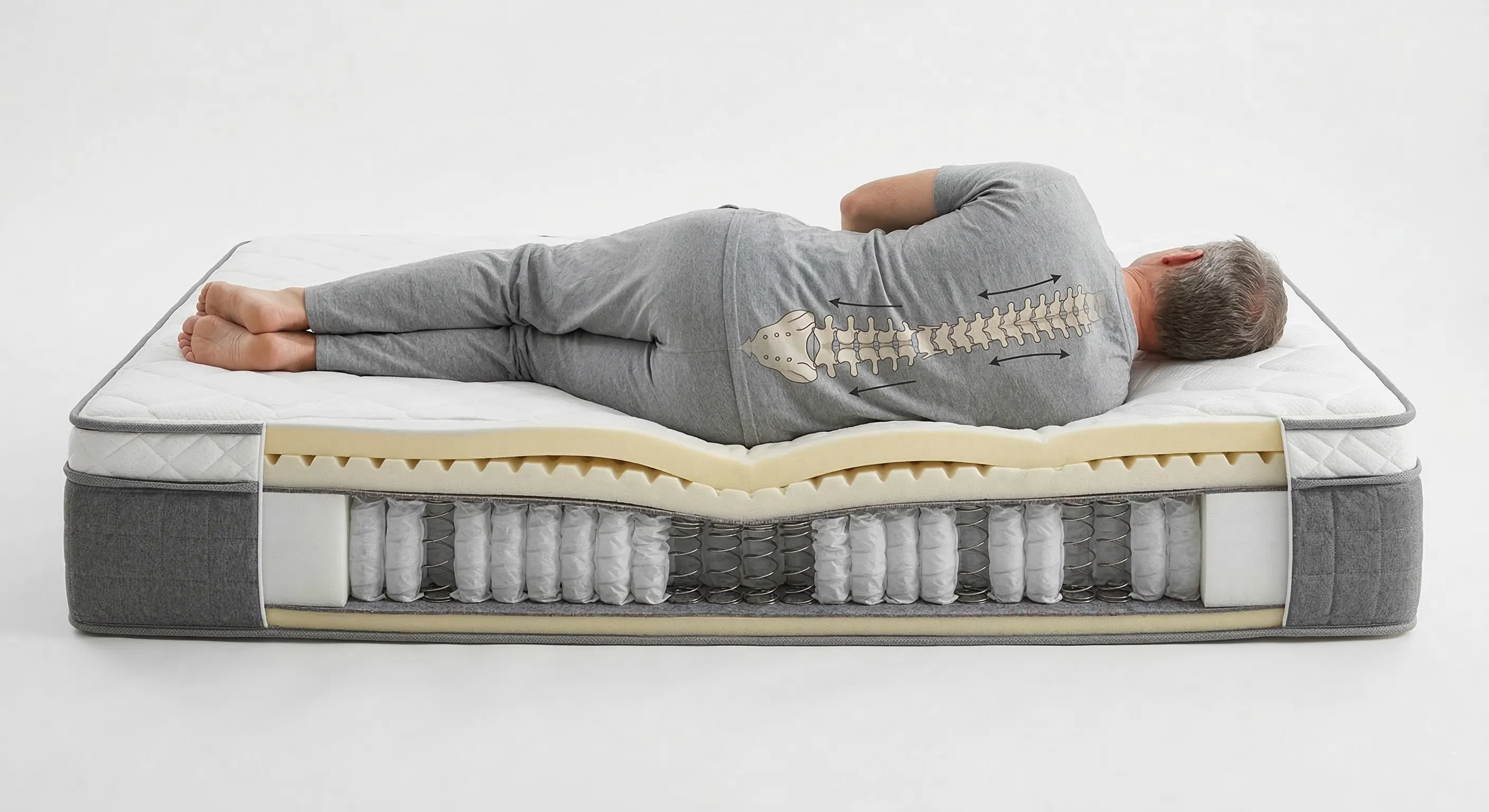
Hybrid mattresses, combining a pocketed coil support system with foam or latex comfort layers, offer the most balanced solution for back pain sufferers across multiple sleeping positions. The pocketed coil system provides strong, responsive support and airflow, while the foam or latex comfort layer provides the pressure relief that prevents the concentrated loading that causes back pain. Zoned hybrid mattresses, with deliberately firmer coils under the hips and softer coils under the shoulders, are specifically designed to maintain lumbar alignment while providing pressure relief at the appropriate points. For most adults with back pain who share a bed or who change positions during the night, a medium-firm hybrid is the most versatile and consistently effective option.
How Sleeping Position Affects Back Pain
The interaction between sleeping position and mattress firmness determines how the mattress causes back pain in four individuals. The same mattress produces different patterns of back pain across different sleeping positions.
Side Sleeping
Side sleeping concentrates body weight on the shoulders and hips. A mattress that is too firm for a side sleeper does not allow these contact points to sink adequately, creating elevated pressure and lateral spinal curvature that strains the lower back and hip on the side being slept on. Side sleepers with back pain on the side they sleep on almost always have a mattress that is too firm for their body weight. Medium to medium-soft firmness (4.5 to 6) with adequate pressure relief layers is required for side sleepers with back pain. A firm pillow between the knees eliminates the pelvic rotation that compounds lower back strain in side sleeping, ng regardless of mattress firmness.
Back Sleeping
Back sleeping distributes weight across the widest surface area and is the most forgiving position when selecting a mattress firmness. However, a mattress that is too soft allows the hips to sink, flattening the lumbar curve and straining the lower back muscles. A mattress that is too firm elevates the lumbar region away from the surface, leaving it unsupported. Medium-firm (5.5 to 7) is the ideal range for back sleepers with back pain. Placing a pillow under the knees when back sleeping reduces lumbar disc pressure by approximately 25% regardless of mattress firmness, making it the single most effective positional adjustment for back-sleeping pain relief. For complete guidance, read our Best Sleeping Position for Back Pain guide.
Stomach Sleeping
Stomach sleeping is the most problematic position for back health, regardless of mattress quality, because it forces the lumbar spine into hyperextension and requires the neck to rotate for breathing. A mattress that is too soft for a stomach sleeper allows the hips to sink more deeply than the chest, exaggerating the lumbar arch and directly compressing the spinal discs and facet joints. Stomach sleepers with back pain need a firm mattress (6.5 to 8) to keep the pelvis level with the torso. However, transitioning away from stomach sleeping entirely is the most effective intervention for stomach sleepers' back pain, as no mattress firmness can fully eliminate the lumbar extension that stomach sleeping inherently creates.
How Often You Should Replace Your Mattress
One of the most overlooked causes of mattress-related back pain is simply sleeping on a mattress that has exceeded its useful lifespan. Even a high-quality mattress from a reputable manufacturer eventually loses the structural integrity needed to support the spine correctly.
Typical Mattress Lifespan: Memory foam and hybrid mattresses typically last 8 to 10 years. Latex mattresses last 10 to 15 years. Innerspring mattresses average 6 to 8 years before significant coil fatigue develops. Budget foam mattresses can degrade in as little as 4 to 6 years. These lifespans mark the point at which most mattresses begin to show structural deterioration that compromises spinal support.
Signs of Mattress Aging: The key aging signs that indicate back pain risk include visible body impressions greater than 1.5cm, surface sagging that is noticeable when lying down, noise from coil springs during movement, reduced resilience (the mattress does not spring back promptly when pressed), and a general feeling that the mattress surface is uneven or lumpy. Any of these signs,s in combination with back pain that began gradually over recent months,s is strong evidence that the mattress has aged beyond its useful structural life.
When Replacement Is Necessary: Replace your mattress when it is over 8 years old, you are experiencing morning back pain, visible sagging or body impressions, you consistently sleep better in other beds, or the mattress surface feels noticeably different from how it felt when new. Delaying replacement to save money while continuing to sleep on a pain-causing mattress is a false economy, given the health costs of persistent back pain.

Tips to Reduce Back Pain While Sleeping
While mattress replacement or improvement is the primary intervention for mattress-related back pain, these complementary strategies provide additional relief:
- Use Proper Pillow Support: Back sleepers should place a medium-firm pillow under the knees to reduce lumbar disc pressure. Side sleepers should place a firm pillow between the knees to keep the pelvis level and eliminate lower back rotation. These pillow adjustments cost nothing and produce immediate pain relief that compounds with mattress improvements.
- Maintain Correct Sleeping Posture: Back sleeping with knees elevated and side sleeping with a knee pillow are the two positions most protective of the lower back. Stomach sleeping is the most damaging and should be actively avoided, using a body pillow along the front of the body to prevent unconscious rolling during the night.
- Choose the Right Mattress Firmness: Medium-firm, in the 5.5 to 7 range, suits most back pain sufferers across most sleeping positions. Adjust within this range based on your sleeping position and body weight as described in this guide. For a complete firmness selection guide, read our Mattress Firmness Guide, and for our full mattress recommendation for back pain, read our Best Mattress for Back Pain guide.
- Add a Mattress Topper: If replacing your mattress immediately is not possible, a 5-7cm memory foam or latex topper can add surface pressure relief to a too-firm mattress or provide slightly more support on a too-soft one. A topper cannot fix a severely sagging or worn mattress, but can meaningfully improve sleep comfort on a mattress that is slightly outside the ideal firmness range.
- Maintain Healthy Sleep Habits: Pre-sleep stretching, particularly the knee-to-chest and cat-cow stretches, reduces muscular tension that can compound mattress-related back pain. A consistent sleep schedule, a cool bedroom, and complete darkness all improve sleep quality, reducing sensitivity to pain and enhancing the body's overnight recovery capacity.
Conclusion
The answer to the question "Can a mattress cause back pain?" is clearly yes, and for millions of people, the mattress is the primary and most directly correctable cause of the back pain they wake up with every morning. The characteristic pattern of morning stiffness that gradually eases during the day, sleeping better in other beds, and visible mattress sagging are the clearest diagnostic signs that the mattress is the source rather than a contributing factor.
Addressing mattress-related back pain requires matching mattress firmness to your sleeping position and body weight, choosing a material that balances pressure relief with consistent spinal support, and replacing mattresses that have exceeded their structural lifespan. Medium-firm mattresses in the 5.5 to 7 range, in memory foam, latex, or hybrid construction, resolve the majority of cases of mattress-related back pain when correctly matched to the individual. The investment in the right mattress is not a comfort purchase. It is a health investment that pays back every morning you wake without pain.
Also read: Best Mattress for Back Pain Complete Relief Guide
Related: Mattress Firmness Guide: How to Choose the Perfect Level
Further reading: Best Sleeping Position for Back Pain Expert Guide