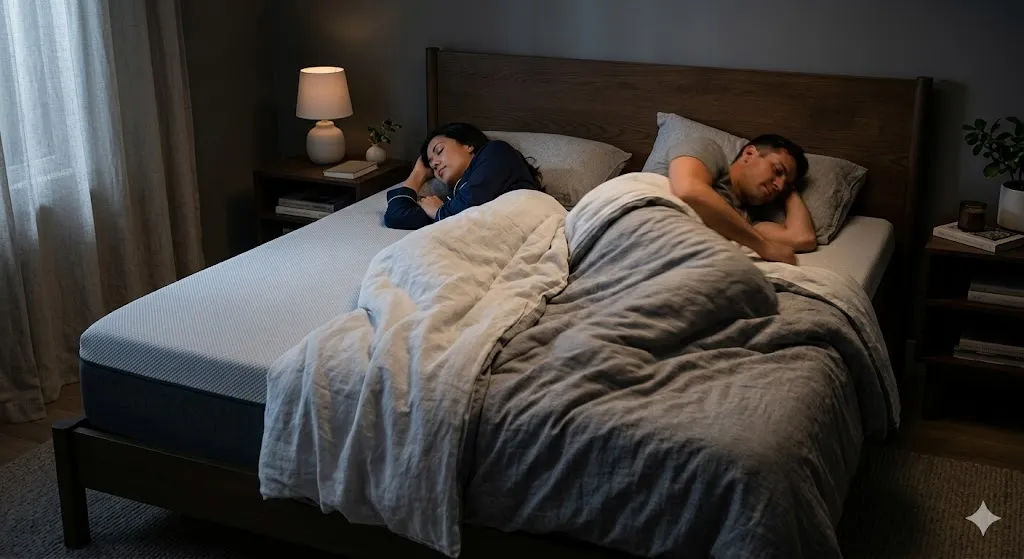
Sleeping with a partner is one of the most common causes of disrupted sleep that people rarely identify correctly. Most couples who wake up feeling unrested assume the problem is stress, a busy mind, or simply not getting enough hours in bed. The actual cause, in many cases, is the mattress. Every time one partner shifts position, rolls over, gets up to use the bathroom, or adjusts their pillow during the night, that movement travels through the mattress and registers as a disturbance on the other side of the bed. For light sleepers, this can mean being partially or fully roused from sleep dozens of times per night without ever having a clear memory of it in the morning.
A motion-isolation mattress is specifically designed to absorb the energy of movement at the point of impact and prevent it from travelling across the sleep surface to disturb the other sleeper. Understanding what motion isolation is, how it works, and which mattress types perform best is one of the most practical steps any couple can take toward consistently better sleep. This complete guide covers everything you need to know about motion transfer, how to evaluate it, and how to choose a mattress that keeps both partners sleeping undisturbed through the night.
What Is Motion Isolation in a Mattress?
Motion isolation refers to a mattress's ability to contain movement within a localised area of the sleep surface rather than allowing it to spread across the entire mattress. When a mattress has strong motion isolation, a movement made on one side of the bed, such as a partner rolling over or getting up, is absorbed by the material immediately around that movement and does not register on the other side of the mattress as a noticeable disturbance.
It is important to understand the distinction between motion isolation and motion transfer, as the two terms describe opposite ends of the same performance spectrum. Motion transfer occurs when a mattress fails to contain movement; the energy of one person's action travels through the mattress material and is felt by anyone else lying on the same surface. Motion isolation is what happens when the mattress succeeds; the movement is absorbed and contained, leaving the rest of the sleep surface undisturbed.
How a mattress absorbs movement depends entirely on the properties of its materials. Dense, viscoelastic materials like memory foam convert the energy of movement into heat rather than transmitting it as a wave through the mattress. Materials that are springy or interconnected, like traditional coil systems, do the opposite; they amplify movement energy and send it outward across the surface. Understanding this distinction is the foundation for choosing the right motion-isolating mattress for your specific sleeping situation.
Motion isolation is measured and discussed by how much a disturbance at one point on a mattress is felt at a distance from that point. The most commonly used test involves placing a glass of water on one side of a mattress and dropping a heavy object on the other side to observe how much the water ripples. The less the water moves, the better the mattress's motion isolation performance.
Why Motion Isolation Matters for Sleep Quality
The impact of motion transfer on sleep quality is consistently underestimated because the disturbances it creates are often subtle enough not to fully wake the sleeper, yet significant enough to pull them out of their deepest sleep stages. This is sometimes referred to as microarousal, a partial awakening that lasts only seconds but interrupts the natural sleep cycle and reduces the restorative quality of sleep without leaving a clear memory trace.
When microarousals happen repeatedly throughout the night, the sleeper spends less total time in deep slow-wave sleep and REM sleep, which are the stages responsible for physical recovery, memory consolidation, emotional regulation, and immune function. The cumulative effect of nights filled with microarousals is a form of chronic sleep deprivation that produces fatigue, reduced concentration, mood instability, and long-term health consequences even in people who believe they are sleeping a full eight hours.
For couples, the challenge is compounded by the fact that each partner's sleep quality depends in part on the other partner's behaviour during the night. A partner who moves frequently, gets up during the night, or has restless sleep can unknowingly be the primary cause of the other partner's sleep problems. In many relationships, this becomes a source of frustration and conflict, with neither person understanding that the mattress, not the partner's behaviour, is the root of the issue.
Choosing a motion-isolation mattress removes this source of sleep disruption from the equation entirely. When movement is absorbed at the point of origin, both partners can sleep through each other's nighttime movements completely undisturbed, and both experience the full depth and duration of sleep their bodies need.
How Motion Transfer Happens
Motion transfer occurs when the materials within a mattress transmit energy from one point to another rather than absorbing it. The mechanism behind this is straightforward: every movement on a mattress surface generates a wave of mechanical energy that travels through the material that makes up the mattress structure. The physical properties of that material determine how far and how strongly that wave travels before it dissipates.
In a mattress built around a connected coil system, all springs are physically linked together. When pressure is applied to one area, every connected spring in the system responds. This creates a ripple effect that travels clearly from one side of the mattress to the other, meaning that even a gentle movement by one partner can be felt distinctly by the other. Traditional innerspring mattresses are the most extreme example of high motion transfer for this reason.
In a mattress built from dense foam, the material lacks a connected mechanical structure to transmit force. Instead, it locally absorbs the energy of movement, converting it within the foam's cellular structure without sending it outward as a wave. The denser and more viscoelastic the foam, the more completely it absorbs movement, and the less motion transfer occurs.
Material structure, density, and the presence or absence of mechanical components are therefore the key determinants of how much motion transfer a mattress produces. This is why mattress type is the most important factor when evaluating a motion-isolating mattress for couples or light sleepers.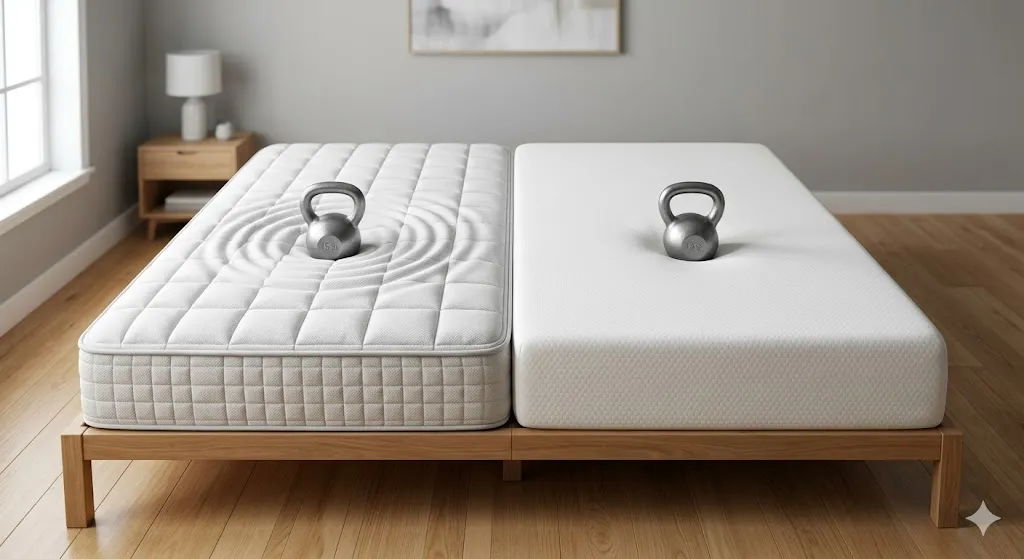
Best Mattress Types for Motion Isolation
Different mattress types offer dramatically different levels of motion isolation. Understanding how each type performs helps you identify which category is most appropriate for your situation before comparing specific products.
Memory Foam Mattress
Memory foam mattresses provide the best motion isolation of any mattress type available. The dense, viscoelastic foam structure absorbs movement completely at the point of contact, converting the mechanical energy of the movement into heat within the foam's cellular structure. This means that a partner rolling over, getting out of bed, or shifting position creates virtually no detectable disturbance on the other side of the mattress.
The slow, contouring response of memory foam is directly related to its excellent motion isolation. Because the material responds slowly to pressure changes rather than springing back immediately, it does not create the rebounding wave effect that causes motion transfer in more responsive materials. For couples in which one partner is a light sleeper or moves frequently during the night, a memory foam mattress is the most reliable option.
The main trade-off to consider is heat retention. Traditional memory foam traps body heat, which is a more pressing concern when two people share the mattress. Modern gel-infused and open-cell memory foam options manage temperature more effectively while retaining the material's outstanding motion isolation properties.
Latex Mattress
Natural latex provides good motion isolation, though not quite at the level of memory foam. Latex absorbs movement effectively and lacks the connected mechanical structure of a coil system, so disturbances remain relatively localised. The key difference from memory foam is that latex is more responsive; it springs back more quickly when pressure is released, rather than slowly recovering. This responsiveness means that very forceful movements, such as someone getting out of bed abruptly, may produce a slightly more noticeable disturbance on a latex mattress than on a memory foam mattress.
For most couples, latex's motion isolation is more than adequate and offers significant advantages over memory foam in breathability, durability, and buoyancy. Couples who sleep warm will generally find that latex's superior cooling properties make it the better overall choice, even though its motion isolation is marginally less complete than memory foam.
Hybrid Mattress
Hybrid mattresses combine a pocketed coil support system with foam or latex comfort layers, offering balanced motion isolation. The critical distinction between hybrid mattresses and traditional innerspring mattresses is the type of coil system used. In a hybrid mattress, each coil is individually wrapped in fabric so that it moves independently rather than as part of a connected unit. This pocketed coil design significantly reduces the wave effect that causes motion transfer in traditional spring systems.
The foam or latex comfort layers on top of the coil system add further motion absorption at the sleep surface. The result is a mattress that manages motion transfer reasonably well while also delivering the airflow, edge support, and responsive feel that make hybrids such a versatile option for couples. Hybrid mattresses do not match the motion isolation of an all-foam or latex mattress, but they perform adequately for most couples and compensate with superior cooling and edge support.
Innerspring Mattress
Traditional innerspring mattresses with connected coil systems offer the poorest motion isolation of any mainstream mattress type. The interconnected spring structure transmits movement freely from one side of the mattress to the other, meaning that any significant movement by one partner is clearly felt across the entire sleep surface. For couples where motion transfer is a concern, traditional innerspring mattresses are not recommended as a primary choice.
It is worth noting that some modern innerspring mattresses use individually pocketed coil systems rather than traditional connected springs. These perform considerably better at motion isolation, though they still do not match the performance of an all-foam or latex mattress at the comfort-layer level. If an innerspring-style mattress is preferred for its firm, bouncy feel and airflow properties, looking specifically for a pocketed-coil version will significantly reduce motion transfer.
Memory Foam vs Hybrid: Which Is Better for Motion Isolation?
The comparison between memory foam and hybrid mattresses for motion isolation is one of the most common questions from couples evaluating their options, and the answer depends on how strictly motion isolation is prioritised relative to other factors.
Pure memory foam consistently outperforms hybrid mattresses for motion isolation. The all-foam construction has no mechanical spring component to transmit movement, and the density of memory foam absorbs disturbances so thoroughly that even couples in which one partner moves frequently during the night typically experience minimal disruption on a quality memory foam mattress. If motion isolation is the single most important factor in your mattress decision, memory foam is the clear winner.
However, hybrid mattresses close this gap considerably compared to older spring-based designs, and they offer meaningful advantages in areas where memory foam falls short. The coil core of a hybrid promotes airflow that memory foam cannot match, making it significantly cooler for couples who share body heat at night. The edge support of a hybrid is typically stronger, making better use of the mattress's full width. And the responsive, bouncy feel of a hybrid suits couples who find the slow, enveloping sensation of memory foam uncomfortable or restricting.
For couples who prioritise motion isolation above cooling and feel, memory foam is the better choice. For couples who need a balance of motion isolation, cooling, edge support, and comfort feel, a quality hybrid with individually pocketed coils is a strong and practical alternative. Our guide to the best mattress for couples covers this comparison in greater detail, along with recommendations on size and firmness.
Factors That Affect Motion Isolation
Motion isolation is not solely determined by mattress type. Several specific construction variables influence how well any given mattress manages movement, and understanding them helps you evaluate products more accurately.
Mattress material is the primary factor, as discussed throughout this guide. Dense viscoelastic materials like memory foam absorb movement most completely. Responsive materials like latex absorb movement well, but with slightly more rebound. Coil systems transmit movement unless individually pocketed.
Foam density is directly related to motion isolation performance. Higher-density memory foam absorbs movement more completely than lower-density alternatives. A high-density memory foam comfort layer of 50 kg per cubic metre or above will provide noticeably better motion isolation than a lower-density foam at 30 to 40 kg per cubic metre. When comparing memory foam mattresses specifically for motion-isolation performance, checking the density specification is one of the most reliable indicators of quality.
Mattress thickness also influences motion isolation. Thicker mattresses generally provide more material to absorb the energy of movement before it reaches the other side of the sleep surface. A mattress 25 to 30 cm thick with substantial comfort layers will typically outperform a thinner 18 to 20 cm option in motion isolation, all else being equal.
Construction layers and their arrangement affect the overall motion-isolation profile. A mattress with thick, dense foam comfort layers sitting atop a coil support core will isolate motion more effectively than one with thin foam layers that allow the coils to influence the surface feel. The depth and quality of the comfort layers are therefore as important as the support core when evaluating motion isolation.
How to Test Motion Isolation Before Buying
Testing motion isolation before committing to a mattress purchase is highly recommended, and there are several reliable ways to evaluate performance, whether you are shopping in a store or online.
In-store testing is the most direct method. Visit the showroom together and lie on the mattress at the same time. Ask your partner to make deliberate movements, rolling over, lifting and dropping a knee, getting up from their side, while you remain still and focus on what you feel. A mattress with good motion isolation will produce little to no detectable movement on your side. Pay particular attention to getting-up movements, which tend to create the most significant disturbances in practice.
For online purchases, independent reviews from verified couples are the most reliable source of real-world motion isolation data. Look specifically for reviews that mention partner disturbance, nighttime movement, or being woken by a partner. Patterns across multiple reviews from couples will give you a much more accurate picture of motion isolation performance than any manufacturer specification.
Trial periods are essential when buying a motion isolation mattress online. A sleep trial of at least 30 nights allows both partners to evaluate the mattress under genuine sleeping conditions across a range of nights and movement patterns. Always confirm the returns process is straightforward before purchasing, so that if the mattress does not perform as expected, the return is not a barrier to making the right long-term choice. See our full guide to choosing the right mattress for additional buying advice.
Tips to Reduce Motion Transfer While Sleeping
Beyond choosing the right mattress type, several practical adjustments can further reduce the impact of motion transfer on shared sleep quality.
Choose a thicker mattress with substantial comfort layers. A mattress of at least 25 to 30 cm with high-density foam or latex comfort layers provides significantly more motion absorption than a thinner design. The additional material gives the movement energy more distance to dissipate before it reaches the other side of the bed.
Use a memory foam or latex mattress topper on your existing mattress. If replacing the entire mattress is not immediately practical, adding a quality foam topper of 5 to 8 cm significantly improves motion isolation at the sleep surface without the cost of a full replacement. This is a useful interim solution while saving for a long-term upgrade.
Choose a king-size bed where possible. A wider sleep surface means that each partner's movements are farther from the other by default, reducing the distance motion energy must travel to cause a disturbance. Our mattress firmness guide and size recommendations explain how to match mattress dimensions to your bedroom space.
Ensure the bed base or foundation is sturdy and appropriate for the mattress type. A worn or unsuitable bed base can amplify motion transfer by creating additional bounce or instability in the mattress above it. A solid platform base or a slatted base with slats spaced no more than 6 cm apart provides the most stable foundation for a motion-isolation mattress.
Who Needs a Motion Isolation Mattress?
While any sleeper benefits from a mattress that minimises unnecessary disturbances, certain groups stand to gain the most from prioritising motion isolation when choosing a mattress.
Couples are the most obvious beneficiaries. Any two people sharing a bed are affected by each other's movements during the night, and the mattress's motion isolation directly determines how much those movements disrupt each other's sleep. This applies equally to couples with similar sleep patterns and to those where one partner is a significantly more restless or frequent mover than the other.
Light sleepers are disproportionately affected by motion transfer because they are more easily roused from sleep by subtle disturbances. A light sleeper sharing a bed with a partner who moves frequently will experience significant sleep disruption on a mattress with poor motion isolation, and may find that switching to a high-quality motion isolation mattress produces a dramatic improvement in their nightly sleep quality.
People with irregular sleep patterns, such as those who work night shifts, experience insomnia, or have health conditions that affect sleep continuity, are also well served by strong motion isolation. Any reduction in external disturbances helps these sleepers maintain whatever sleep continuity they can achieve.
Conclusion
A motion-isolation mattress is not a luxury feature; for couples and light sleepers, it is one of the most practical benefits a mattress can offer. Motion transfer is one of the leading causes of disrupted sleep among couples, and it operates largely below the threshold of full conscious awareness, making it easy to overlook as the source of persistent fatigue and poor sleep quality. Memory foam provides the best motion isolation of any material, followed closely by natural latex and high-quality hybrid mattresses with individually pocketed coils. Traditional innerspring mattresses with connected coil systems transfer the most motion and should be avoided by couples sensitive to partner disturbance.
Evaluating motion isolation through in-store testing, verified reviews, and sleep trials before committing to a purchase ensures that both partners get the undisturbed sleep their bodies need every night. Combined with the right mattress size, firmness balance, and cooling properties, a quality motion isolation mattress is one of the most effective investments any couple can make in their shared sleep quality and long-term health.