Mattress Thickness Guide: Choosing the Right Mattress Height
When buying a new mattress, most people focus on brand, price, or material — but one of the most important factors often gets completely overlooked: mattress thickness. The thickness of your mattress directly affects how comfortable you sleep, how well your spine is supported, and how long it lasts.
Whether you are a lightweight sleeper, someone with chronic back pain, or simply looking for the best mattress thickness for your sleeping style, choosing the wrong height can mean restless nights and aching mornings. A mattress that is too thin may sag quickly and fail to support heavier body types, while a mattress that is unnecessarily thick can make it difficult to get in and out of bed.
This mattress thickness guide breaks down everything you need to know, from standard thickness levels and comparison tables to body weight, sleeping position, and back pain recommendations. By the end, you will know exactly what mattress height is right for you.
What Is Mattress Thickness?
Mattress thickness refers to the total height of a mattress measured in inches from the bottom base to the very top surface. It is one of the most overlooked specifications when shopping for a mattress, yet it plays a significant role in determining your overall sleep quality and comfort.
A standard mattress is not made from a single block of material. It is constructed with multiple layers, each serving a specific function. The two primary sections are the comfort layer and the support layer.
The comfort layer sits on top and is typically made of memory foam, latex, pillow-top foam, or gel-infused foam. This is the layer you feel most directly when you lie down. It cushions your body, relieves pressure points, and determines how soft or plush the mattress feels. Comfort layers generally range from 2 to 4 inches in thickness.
The support layer forms the foundation of the mattress. It is usually made from high-density foam, innerspring coils, or pocketed springs. This layer supports your body weight, maintains spinal alignment, and provides the mattress's structural durability. Support cores are typically 6 to 8 inches thick.
The combined height of these layers gives you the total mattress thickness. A thicker mattress usually means more comfort layers, offering deeper cushioning, better pressure relief, and often longer durability. Understanding this structure is the first step in using a mattress thickness guide to make the right choice for your sleep needs.
Standard Mattress Thickness Levels
Mattresses generally fall into four thickness categories. Each category serves a different type of sleeper and sleeping environment. Here is what you need to know about each level in this mattress height guide.
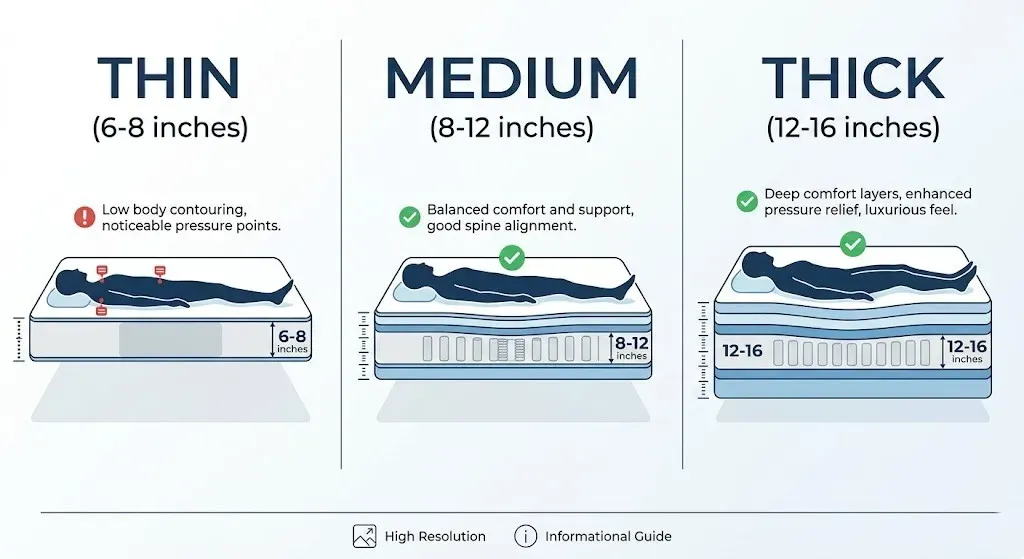
Thin Mattress (6–8 Inches)
Thin mattresses in the 6 to 8-inch range are the most basic option available. They are best suited for lightweight sleepers, young children, toddler beds, bunk beds, or guest room use where the mattress is not used every night. These mattresses typically have a minimal comfort layer of 1 to 2 inches sitting on a basic support core.
While affordable and easy to handle due to their low weight, thin mattresses are generally not recommended for adults as a primary sleeping surface. They wear out faster, offer limited pressure relief, and may not provide adequate spinal support for regular use. If you are an adult over 130 lbs sleeping on one every night, a 6 to 8-inch mattress is likely to feel uncomfortable within a short period.
Medium Thickness (8–10 Inches)
The 8 to 10-inch range is considered the standard thickness for most mattresses sold today. This category works well for average-weight sleepers — typically those between 130 and 230 lbs — who need a good balance of comfort and support without spending heavily. Most mattresses in this range include a 2 to 3-inch comfort layer over a solid 6 to 7-inch support base.
This is a reliable choice for back and stomach sleepers who need firm support, and it also works decently for side sleepers of average build. For most adult sleepers, an 8- to 10-inch mattress offers enough cushioning and durability to last for several years.
Thick Mattress (10–12 Inches)
Mattresses in the 10 to 12-inch range are the most popular choice for adult sleepers today and for good reason. This is where comfort, support, and durability all come together in a balanced way. These mattresses typically feature a 3 to 4-inch comfort layer over a robust 7 to 8-inch support core, making them suitable for most body types, sleeping positions, and sleep health needs.
If you are looking for a mattress that works well whether you sleep on your side, back, or stomach, a 10 to 12-inch mattress is almost always a safe choice. It is also the minimum recommended thickness for heavier sleepers who need additional support to prevent the mattress from bottoming out over time.
Extra Thick Mattress (12+ Inches)
Extra-thick mattresses, 12 inches or thicker, are considered premium or luxury options. They are designed for heavy sleepers weighing over 230 lbs, couples sharing a bed, or anyone who prioritizes the feeling of sleeping in a cloud-like surface. These mattresses often include multiple comfort layers — sometimes a combination of memory foam, latex, and gel — over a reinforced support core.
While they offer exceptional comfort and longevity, extra-thick mattresses come at a higher price point and are significantly heavier to move or rotate. They may also require a sturdy bed frame that can handle the added height and weight.
Mattress Thickness Comparison Table
Use this quick-reference mattress thickness guide table to find the ideal mattress height for your specific situation.
| Thickness | Best For | Comfort Level | Durability | Price Range |
|---|---|---|---|---|
| 6–8 Inch | Kids, lightweight sleepers, bunk beds, guest rooms | Basic | Low–Medium | Budget |
| 8–10 Inch | Average weight sleepers, back and stomach sleepers | Balanced | Medium | Mid-range |
| 10–12 Inch | Most adults, all sleeping positions | Comfortable | High | Mid to High |
| 12+ Inch | Heavy sleepers, couples, and luxury preference | Premium | Very High | Premium |
This table summarizes the key differences across thickness levels. Most sleepers will find their ideal range in the 10 to 12-inch column, but your specific body weight and sleep style will ultimately determine what works best for you, which is exactly what the following sections in this mattress height guide will help you figure out.
How Body Weight Affects Mattress Thickness
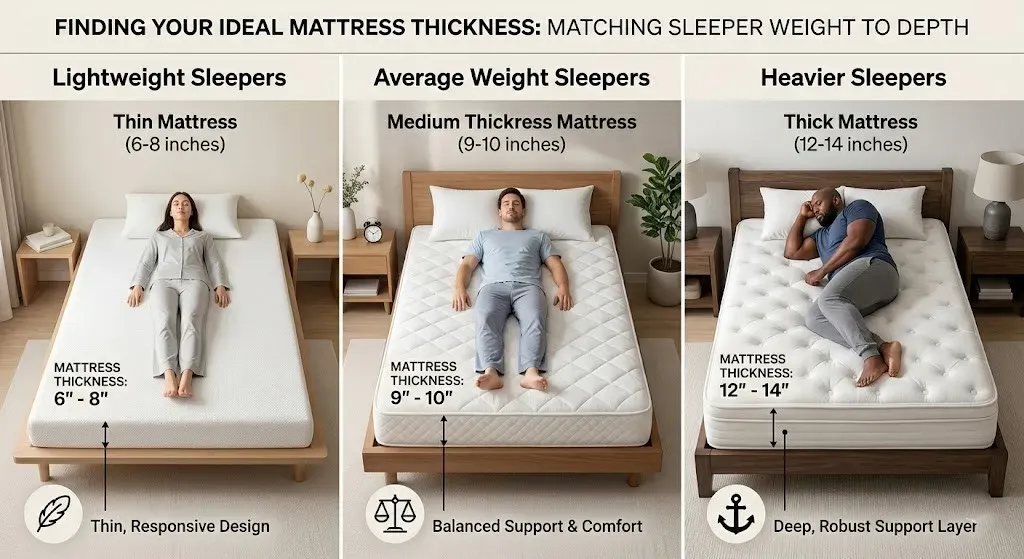
Body weight is one of the single most important factors when determining the right mattress thickness. A mattress that works perfectly for a 130-lb person may offer zero support for someone weighing 250 lbs. Here is how to think about it.
Lightweight Sleepers (Under 130 lbs): Lighter individuals do not compress mattress layers as deeply, which means they do not need as much foam depth to feel comfortable. A mattress in the 6 to 10-inch range is usually sufficient. Going too thick can actually work against lightweight sleepers, because they may not sink into the comfort layers enough to feel any pressure relief, and the mattress can feel too firm despite having thick foam on top. A medium-firm 8 to 10-inch mattress is typically the sweet spot for this group.
Average Weight Sleepers (130–230 lbs): This is the range most mattresses are designed for. Sleepers in this weight category compress comfort layers moderately and benefit from the balanced support of a 10 to 12-inch mattress. They need enough comfort foam to relieve pressure at the shoulders, hips, and knees, while the support core needs to be firm enough to prevent the spine from sinking out of alignment. Most 10-inch mattresses perform very well here.
Heavy Sleepers (Over 230 lbs): Heavier sleepers put significantly more pressure on a mattress, so thinner mattresses will compress quickly and lose their support much faster than expected. For anyone over 230 lbs, a mattress at least 12 inches thick is recommended, ideally one with a high-density support core of 1.8 PCF or higher. Without adequate thickness, heavier sleepers risk sleeping in a hammock-like dip that strains the lower back and disrupts spinal alignment throughout the night.
Best Mattress Thickness for Different Sleeping Positions
Your sleeping position determines how your body weight is distributed across the mattress surface — and that directly impacts what thickness provides the best comfort and spinal support. This is a key part of any mattress thickness guide.
Side Sleepers
Side sleeping puts the most concentrated pressure on two areas: the shoulders and the hips. These are the widest parts of the body, and they need to sink into the mattress comfort layer enough to keep the spine in a neutral, horizontal line. If the mattress is too thin or too firm, the shoulders and hips will not be adequately cushioned, creating painful pressure points and forcing the spine into a bent or angled position.
For side sleepers, a mattress 10 to 12 inches thick is ideal, with a comfort layer of 3 to 4 inches to allow proper contouring. This is especially important for side sleepers with broader shoulders or wider hips. A softer to medium firmness in this thickness range tends to work best. If you are a side sleeper looking for more guidance, check out our detailed guide on the Best Mattress for Side Sleepers.
Back Sleepers
Back sleeping is generally the most spine-friendly position when the mattress is the right thickness and firmness. The weight is spread more evenly across a larger surface area than when sleeping on the side, reducing concentrated pressure. However, back sleepers still need a mattress that supports the natural curvature of the lumbar spine without allowing the lower back to sink too deeply.
A mattress of 8 to 12 inches works well for most back sleepers, with a medium to medium-firm feel. The support core must be robust enough to maintain alignment of the hips and lower back. Too soft a mattress, regardless of thickness, will cause the hips to sag, which strains the lower back significantly. Back sleepers who experience discomfort should also read our guide on the Best Mattress for Back Pain.
Stomach Sleepers
Stomach sleeping is considered the most challenging position for spinal alignment. When lying face down, the hips can sink too deeply into a soft mattress, which causes the lower spine to arch upward in an unnatural curve. Over time, this puts enormous strain on the lumbar vertebrae and can lead to chronic lower back pain.
Stomach sleepers generally need a firmer, slightly thinner mattress, typically 8 to 10 inches, with a thin comfort layer of 1 to 2 inches and a firm, dense support core. This prevents the hips from sinking while still providing enough surface cushioning to prevent discomfort in the chest and abdomen. Extra-thick plush mattresses are generally not recommended for stomach sleepers.
How Mattress Thickness Affects Comfort and Support
Mattress thickness is not just about how high the bed sits off the floor. It has a direct and measurable impact on three critical sleep quality factors.
Pressure Relief: The comfort layers at the top of the mattress cushion your body and distribute weight evenly. A thicker mattress typically means more comfort foam, which translates to better pressure relief at the hips, shoulders, and knees — especially important for side sleepers and those with joint pain. A thin mattress with only 1 to 2 inches of comfort foam cannot adequately cushion these pressure points, leading to discomfort and frequent nighttime position changes.
Spinal Alignment: The support core at the bottom of the mattress keeps your spine in a neutral position throughout the night. A mattress that is too thin for your body weight will compress to the point where the support core can no longer do its job — your spine will begin to curve into the mattress rather than resting in a healthy, straight line. Proper mattress thickness ensures the support core maintains its integrity even under your full body weight night after night.
Durability and Longevity: Thicker mattresses generally last longer because there is more material to absorb compression over time. A 6-inch mattress used by an average-weight adult may develop body impressions and lose its supportive feel within 2 to 3 years. A quality 12-inch mattress used by the same person can remain supportive and comfortable for 8 to 10 years or more, depending on material quality. When considering mattress thickness, always consider the long-term cost per year, not just the upfront price.
Best Mattress Thickness for Back Pain
Back pain is one of the most common reasons people replace their mattress, and in many cases, choosing the wrong thickness is part of the problem. The best mattress thickness for back pain depends on your weight, sleeping position, and mattress firmness.
For most adults with lower back pain, a mattress in the 10- to 12-inch range offers the ideal balance between comfort and support. This thickness provides enough cushioning to relieve pressure on the lumbar region while maintaining a firm enough support base to keep the spine properly aligned. A mattress that is too thin — especially for heavier individuals — will bottom out and allow the lower back to sag, which is one of the most common causes of mattress-related back pain.
Firmness and thickness work together when addressing back pain. A thick but overly soft mattress will let the hips and lower back sink too deeply, creating a curved spine position that causes pain. A thin but very firm mattress will not provide adequate pressure relief, creating tension and soreness at contact points. The ideal combination for most back pain sufferers is a medium-firm mattress 10 to 12 inches thick, which offers both support and surface comfort.
People with more severe or chronic back conditions should also consider a mattress that specifically supports the lumbar curve without excessive sinkage. For a detailed breakdown of the best options, visit our guide on the Best Mattress for Back Pain.
Does Mattress Thickness Affect Durability?
Yes mattress thickness and durability are closely related, although the quality of the materials used in each layer matters just as much as the total height.
A thicker mattress distributes body weight compression across more material. This means each layer experiences less wear over time than in a thin mattress, where the limited foam has nowhere to flex without fully compressing. Over months and years of nightly use, thinner mattresses develop body impressions and lose their supportive shape faster than thicker alternatives.
However, a 12-inch mattress made from low-density foam will still wear out faster than a well-constructed 10-inch mattress using high-density, high-quality materials. When evaluating durability as part of your mattress thickness guide decision, look for support cores made from high-density foam of at least 1.8 PCF (pounds per cubic foot), or individually pocketed coils with a high coil count. Comfort layers made from high-quality memory foam or natural latex also hold their shape significantly longer than standard polyfoam.
As a general rule, a quality 10 to 12-inch mattress from a reputable manufacturer should last 7 to 10 years, while a 6 to 8-inch budget mattress may need replacing within 3 to 5 years. Over the long term, the investment in a thicker, higher-quality mattress almost always delivers better value per night of sleep. To understand how to make the right choice from the start, our guide, How to Choose the Right Mattress, covers all the key factors in detail.
Common Mistakes When Choosing Mattress Thickness
Even well-informed buyers make avoidable mistakes when it comes to mattress thickness. Here are the most common ones to watch out for.
Choosing a Mattress That Is Too Thin: This is the single most common mistake, especially among budget-conscious shoppers. A 6 or 7-inch mattress may seem like a reasonable deal, but if you are an adult sleeping on it every night, it is likely to wear out quickly and fail to provide adequate spinal support. Always prioritize at least 10 inches for regular adult use.
Ignoring Body Weight: Many shoppers choose a mattress based solely on feel during a brief showroom test, without considering that body weight significantly affects long-term performance. A mattress that feels comfortable when you sit on it for two minutes in a store may bottom out within months if it is not rated for your weight range.
Focusing Only on Price: The cheapest mattress in the right size is rarely the right mattress. Price should be considered alongside material quality, density ratings, and thickness to ensure you are getting actual value. A slightly more expensive 10-inch mattress with quality materials will almost always outlast and outperform a cheap 12-inch mattress with low-density foam.
Not Accounting for Bed Frame Height: A very thick mattress on a tall bed frame can make it difficult for shorter individuals or those with mobility limitations to get in and out of bed safely. Always measure your total bed height (mattress plus frame) before deciding on thickness.
Assuming Thicker Always Means Better: Thickness is only one variable. A 14-inch mattress made from poor-quality foam is not better than a 10-inch mattress made from premium latex and high-density support foam. Always look at the full picture.
Tips to Choose the Right Mattress Thickness
Now that you understand what can go wrong, here are the most effective tips for using this mattress thickness guide to make the right decision.
1. Start With Your Body Weight: Use the body weight framework above as your starting point. Lightweight sleepers should look for 8 to 10 inches, average-weight sleepers for 10 to 12 inches, and heavy sleepers for 12 inches and above. This alone will significantly narrow your options.
2. Factor In Your Sleeping Position: Side sleepers need thicker comfort layers for pressure relief. Back sleepers need firm support cores. Stomach sleepers need firmer, less plush surfaces. Match thickness with the right firmness for your position.
3. Consider Your Health Needs: If you have back pain, joint pain, or circulation issues, lean toward 10 to 12 inches with a medium-firm feel. These conditions generally improve with better pressure relief and spinal support, which thicker mattresses provide more consistently. Our Mattress Firmness Guide can also help you pair the right firmness with your chosen thickness.
4. Measure Your Bed Frame Height: Sit on the edge of your bed frame and measure the distance from the floor to the top of the frame. Ideally, your finished bed height — frame plus mattress — should place you at approximately knee height for comfortable, safe entry and exit.
5. Check the Density of the Materials: Do not just look at total thickness. Ask about or look up the density of the support core and the type of foam used in the comfort layer. High-density materials in a 10-inch mattress will outperform low-density materials in a 14-inch mattress in both comfort and lifespan.
6. Test Before You Commit: Whenever possible, try the mattress in person for at least 10 to 15 minutes in your actual sleeping position. Many online brands now offer 90 to 120-night sleep trials, which give you the opportunity to test real-world performance before fully committing to the purchase.
Conclusion
Mattress thickness is far more important than most shoppers realize. It affects comfort, support, pressure relief, spinal alignment, and the long-term durability of your investment. As this mattress thickness guide has shown, there is no single right answer; the ideal mattress thickness depends on your body weight, sleeping position, and specific health or comfort needs.
For most adults, a 10 to 12-inch mattress with a high-density support core and a 3 to 4-inch comfort layer offers the best all-around performance. Lightweight sleepers can do well with 8 to 10 inches, while heavy sleepers should consider 12 inches or more for reliable, lasting support.
Take the time to use this mattress height guide alongside your other research and never let price alone make the decision. The right mattress thickness, paired with the right firmness and materials, will reward you with years of comfortable, supportive sleep every single night.