
Orthopedic Mattress: What It Is and How It Helps Back Pain
Back pain has quietly become one of the most common health problems in the world — and a large number of cases trace directly back to poor sleep and the wrong mattress. Millions of people wake up every morning feeling stiff, sore, and exhausted, not because of how long they slept, but because of what they slept on. If your mattress fails to support your spine properly, it can worsen existing pain or even create brand new problems over time.
This is exactly where an orthopedic mattress comes in. You have probably heard the term many times printed on labels, recommended by doctors, and advertised across every price range. But what does it actually mean? And does it genuinely help with back pain, or is it just clever marketing?
Here is the honest truth: not every mattress labeled "orthopedic" is actually designed with your spine in mind. The term is not regulated, which means any manufacturer can use it freely — whether or not the product delivers real support. This guide explains everything clearly so you can make a smart, well-informed choice.
What Is an Orthopedic Mattress?
An orthopedic mattress is a mattress specifically engineered to support the musculoskeletal system — your spine, joints, and muscles — while you sleep. The primary goal is to maintain proper spinal alignment, reduce pressure on sensitive areas, and minimize pain caused by poor sleeping posture.
The concept has roots in medical research. In the mid-20th century, orthopedic surgeons began recommending firmer sleeping surfaces for patients recovering from back injuries or dealing with chronic joint pain. The mattress industry then adopted the term to describe beds built with this supportive philosophy in mind.
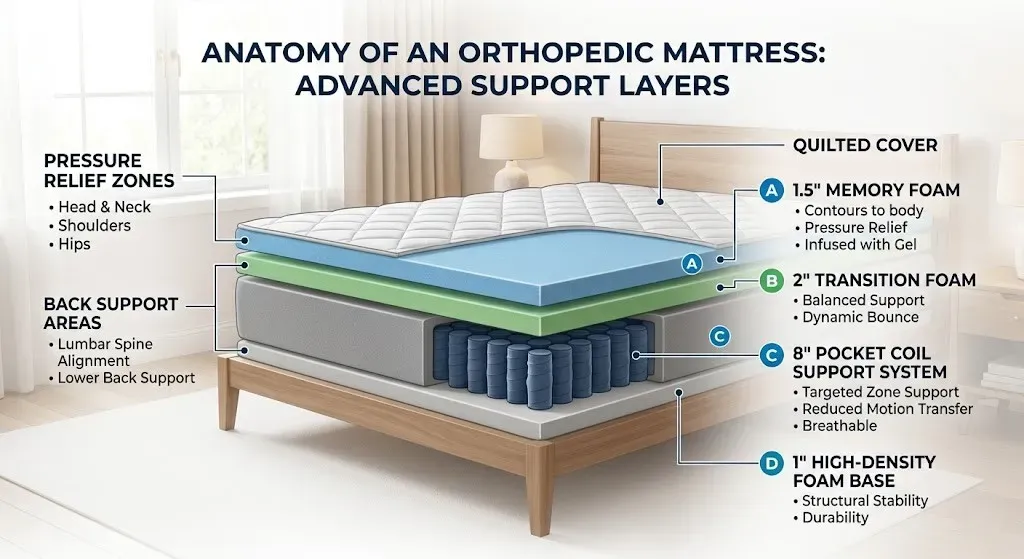
A genuinely supportive model typically features a firm to medium-firm feel that prevents the body from sinking too deeply, multiple support layers that distribute body weight evenly, high-density materials such as foam, latex, or pocketed coils that hold their shape under sustained pressure, and a construction that keeps the spine in a neutral position throughout the night.
Myth vs. Reality: "Orthopedic" is not a protected or certified term. Any manufacturer can put it on a label without meeting specific medical standards. The key is always to look beyond the label and focus on the actual construction, firmness level, and materials used rather than the name alone.
How an Orthopedic Mattress Works

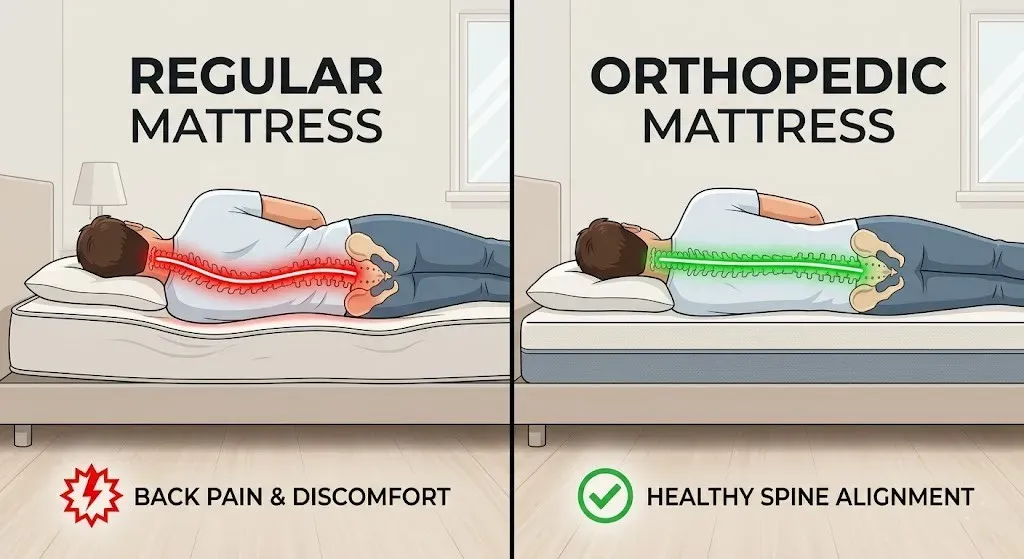
Proper spinal alignment on an orthopedic mattress versus a regular mattress
The core principle behind this type of mattress is straightforward: support the spine in its natural curve while relieving pressure on key contact points. Understanding this mechanism helps you make a smarter purchase.
Spinal Alignment: Your spine has a natural S-shaped curve. When you lie down, the surface beneath you should support that curve — not flatten it and not allow it to sag unevenly. A well-designed orthopedic mattress provides enough firmness to keep your spine aligned from the neck down to the tailbone. This is especially important for side sleepers, whose hips and shoulders need proper cushioning to maintain a level spine.
Weight Distribution: One of the key functions is even weight distribution. When body weight is spread across a larger surface area, no single point bears excessive pressure. This is critical for the lower back, hips, and shoulders — the areas that carry the most load during sleep.
Pressure Relief: High-density foam, memory foam, or individually wrapped coils absorb and redistribute pressure as you lie down. The mattress contours to your body shape, filling in the gaps at the lumbar region while pushing back against heavier areas like the hips. This keeps the spine supported and neutral throughout the night.
Connection to Posture: Sleep posture directly affects waking posture. A mattress that lets your lower back sink trains your spine to hold that misaligned curve during the day too. Over months and years, this contributes to chronic back and neck pain. The right sleeping surface counteracts this by reinforcing good postural habits — even while you are unconscious.
Benefits of an Orthopedic Mattress
Spinal Alignment Support
The most important benefit is maintaining proper spinal alignment. Unlike softer mattresses that allow the spine to sag, a well-built orthopedic mattress keeps your vertebrae in a natural, neutral line. This reduces strain on the muscles, ligaments, and discs surrounding the spine — the structures most commonly responsible for chronic back pain.
Reduces Back and Joint Pain
For people dealing with chronic back pain, herniated discs, sciatica, or arthritis, the right mattress can be genuinely life-changing. By reducing pressure on the lumbar region and supporting the hips and shoulders, it minimizes physical stress placed on joints and surrounding tissue during sleep. Many users report waking up with significantly less pain within the first few weeks of switching.
Improves Sleep Quality
Pain and discomfort are major causes of sleep disruption. When your body is properly supported, you are less likely to toss and turn, wake up mid-sleep, or struggle to fall back asleep. Better physical support creates the right conditions for deeper, more restful sleep — which supports mood, cognitive function, immune health, and physical recovery.
Better Posture
Spending 7 to 9 hours per night on a mattress that keeps your spine properly aligned gradually reinforces good postural habits. Over time, many people find this not only reduces nighttime discomfort but also improves how they carry themselves during the day — less slouching, less neck tension, and greater physical ease.
Who Should Use an Orthopedic Mattress?
Targeted spinal support for people dealing with back pain and joint issues
While almost anyone can benefit from a supportive sleeping surface, certain groups are especially likely to notice a significant improvement after switching to an orthopedic mattress.
Back Pain Sufferers are the most obvious candidates. Whether the pain is acute from an injury or chronic from conditions like a herniated disc or sciatica, proper structural support reduces nighttime strain and helps you wake up with less discomfort.
Office Workers who spend most of their day seated are under constant pressure on the lumbar spine. Poor desk posture throughout the day, combined with an unsupportive mattress at night, compounds the problem significantly.
Elderly People tend to experience more joint and muscle stiffness with age. The right mattress can make a meaningful difference in morning stiffness, mobility, and overall comfort for older adults.
Athletes and Active Individuals put their bodies under significant physical stress. Quality sleep and proper joint support are essential for performance and recovery. A well-chosen mattress is a legitimate recovery tool.
If you are unsure which mattress suits your pain condition best, also read our guide on the best mattress for back pain in India to compare your options.
Orthopedic Mattress vs Regular Mattress
Not sure if it is worth upgrading? Here is a direct comparison between an orthopedic mattress and a regular mattress across the features that matter most.
| Feature | Orthopedic Mattress | Regular Mattress |
|---|---|---|
| Support Type | Targeted, zone-specific | Basic, uniform |
| Spinal Alignment | Yes — engineered for it | Limited |
| Pressure Relief | High | Medium |
| Material Quality | High-density, long-lasting | Variable |
| Durability | High (7–10+ years) | Medium (5–7 years) |
| Pain Reduction | Significant for many users | Minimal |
| Best For | Back pain, joint issues, recovery | General use, healthy sleepers |
| Price Range | Mid to premium | Budget to mid |
The key difference is not just firmness — it is how the mattress is engineered. A regular mattress is designed for general comfort. An orthopedic design is built with a specific goal: to support your musculoskeletal system throughout the night. If you are waking up with pain, stiffness, or poor sleep quality, this upgrade is worth considering.
Best Mattress Types for Orthopedic Support
Memory Foam
Memory foam is one of the most popular materials for spine support. It responds to heat and pressure, contouring closely to the body's shape and filling in the gaps along the spine — particularly the lumbar region. This makes it excellent for pressure relief and pain reduction. It is best suited for side sleepers and people with joint pain. Newer gel-infused variants also address the heat retention issue common in traditional memory foam.
Latex
Natural latex provides firm, responsive support. Unlike memory foam, it bounces back quickly when pressure is applied rather than sinking slowly. This makes it excellent for maintaining spinal alignment without the "stuck" sensation. Latex is also naturally hypoallergenic, cooling, and extremely durable — a good latex mattress can last 12 to 15 years or more. It is ideal for those who want firm support with a breathable, responsive feel.
Hybrid
Hybrid mattresses combine pocketed coils with comfort layers of foam or latex, giving you the deep structural support and breathability of coils paired with the pressure-relieving contouring of foam. This makes hybrids the most versatile option for orthopedic support — they perform well for all sleeping positions and a wide range of body types. They are especially well-suited for combination sleepers and heavier individuals who need robust structural support.
For most people, a medium-firm hybrid or latex mattress offers the best combination of support, pressure relief, and durability.
Best Firmness for an Orthopedic Mattress
Many people assume an orthopedic mattress must be rock-hard. That is not quite right. For most back pain sufferers, a medium-firm rating — typically 5 to 7 on a scale of 1 to 10 — strikes the optimal balance. It is firm enough to prevent the spine from sinking into an unnatural curve, yet soft enough to cushion pressure points like the hips and shoulders.
A mattress that is too soft allows the heavier parts of your body to sink too deeply, tilting the pelvis and throwing the lower spine out of alignment. A mattress that is too firm does not accommodate the body's natural curves, creating tension at the shoulders and lumbar region rather than providing relief.
Your ideal firmness will also vary based on body weight and sleeping position. To understand this in more detail, read our complete mattress firmness guide.
How to Choose the Best Orthopedic Mattress
Choosing the right orthopedic mattress depends on four key factors.
Body Weight: Lighter individuals under 60 kg may find that medium-firm feels too hard and may prefer a slightly softer feel within the medium range. Heavier individuals over 100 kg generally need a firmer mattress with a stronger support core to prevent sagging and maintain proper alignment.
Sleeping Position: Side sleepers need more give at the shoulders and hips — medium to medium-firm works well. Back sleepers need strong lumbar support — medium-firm to firm is ideal. Stomach sleepers need a firmer surface to prevent the hips from sinking. For a detailed breakdown, see our guide on how to choose the right mattress for your sleeping position.
Material: Choose based on your priorities. Memory foam excels at pressure relief and contouring. Latex offers responsive, breathable, long-lasting support. Hybrid mattresses balance both and work well for most body types.
Budget: A good orthopedic mattress is an investment in your health. Look for reputable brands with transparent construction details, generous trial periods of 90 to 365 nights, and solid warranties of at least 10 years. Avoid cheap options that use the label without quality materials to support the claim.
Common Mistakes to Avoid
Buying Based Only on the Label: The term "orthopedic" is unregulated and guarantees nothing on its own. Always review the actual construction — materials used, support layers, and firmness rating. Read verified reviews from people with similar body types and pain conditions.
Choosing the Wrong Firmness: Many buyers go too firm thinking harder equals more supportive, or stay with something too soft thinking softer equals more comfortable. Neither extreme works well for back pain. Use the trial period to assess how the mattress feels after a full week of adjustment rather than judging it on the first night.
Ignoring Body Type and Sleep Position: A mattress that works for a 65 kg side sleeper will not work for a 100 kg back sleeper. These factors matter enormously. Generic "best mattress" lists rarely account for individual variation — personalise your search based on your own body.
Also check our mattress thickness guide to ensure you are selecting the right height for your bed frame and body weight.
Do Orthopedic Mattresses Really Work?
The honest answer: yes — but only if you choose the right one.
There is solid evidence that sleeping on a properly supportive mattress reduces back pain, improves sleep quality, and can contribute to better posture over time. A study published in The Lancet found that medium-firm mattresses significantly reduced back pain and disability in patients with chronic lower back pain compared to firm mattresses.
However, effectiveness depends entirely on quality and fit. A cheaply made orthopedic mattress using low-density foam that loses its shape within a year will offer little benefit. Similarly, a high-quality mattress in the wrong firmness for your body type may not deliver the results you expect. When chosen correctly, it is a genuinely effective tool for better sleep and long-term pain management.
Conclusion
An orthopedic mattress — when backed by quality construction and the right specifications — is a meaningful solution for better spinal support, reduced back and joint pain, and improved sleep quality. Look past the label and focus on materials, firmness, support structure, and how well it matches your body type and sleep position.
Prioritize medium-firm, high-quality materials like latex or hybrid constructions, and always test with a proper trial period. Whether you are dealing with back pain, long hours at a desk, or simply want to improve your sleep health, the right choice will make a noticeable difference in how you feel every morning.