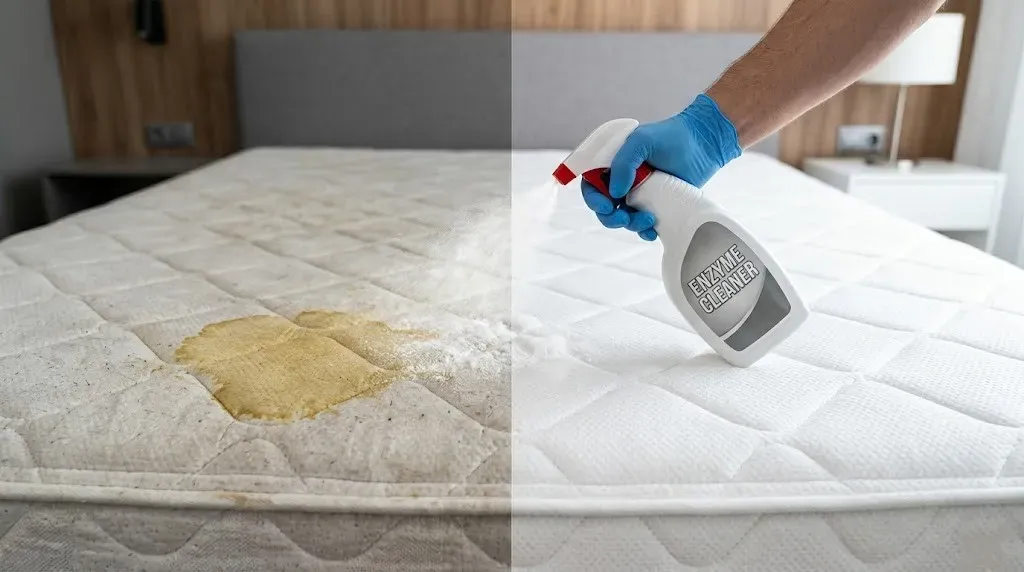
Best Enzyme Cleaner for Mattress Urine
If you have spent any time trying to get urine odour out of a mattress, you have probably come across the term "enzyme cleaner" at some point. And if you have never used one before, you might be wondering what the fuss is about. Let us settle that question right now because the difference between a good enzyme cleaner and any other cleaning product is not small. It is enormous.
What Makes Enzyme Cleaners Different
Most cleaning products work by dissolving or absorbing the substances causing the stain or smell. They lift things off the surface. They mask odours. But they do not actually destroy the compounds responsible for the problem.
Enzyme cleaners work completely differently. They contain biological enzymes, including protease, amylase, and lipase, and, in the pet-specific version, also uricase, which specifically targets uric acid. These enzymes do not just clean around the problem. They literally digest the organic compounds in urine at a molecular level. The uric acid crystals, the ammonia compounds, the odour molecules. All of it gets broken down and destroyed.
That is why the smell does not come back after a proper enzyme cleaner treatment. There is nothing left to produce it.
When Do You Actually Need One
Honestly? Not for every mattress urine situation. For a fresh human urine accident caught quickly, the vinegar-and-baking-soda method often does the job completely. So do not feel like you must rush out and buy an enzyme cleaner for every accident.
But here are the situations where an enzyme cleaner is not optional. It is the only thing that will truly work.
Cat urine. Full stop. Cat urine contains pheromones and extremely concentrated uric acid that vinegar and baking soda cannot fully neutralise. Every guide that tells you baking soda alone sorts cat pee is leaving something out. You need an enzyme cleaner.
Dog urine that keeps coming back. If you have cleaned a dog urine smell and it keeps returning, the uric acid crystals are still in the mattress and enzyme cleaner is what you need to break them down properly.
Old dried stains with strong odours. The older and more concentrated the urine compounds, the more you need the enzymatic approach rather than the surface cleaning approach.
Any urine smell that has persisted despite multiple cleaning attempts. If baking soda and vinegar haven't solved it, enzyme cleaner is the next step.
What to Look For When Buying One
Not all enzyme cleaners are created equal,ual and the market is full of products that call themselves enzyme cleaners without actually containing enough active enzymes to be effective on mattresses.
Look for these things on the label. It should specifically mention urine or pet urine as .an active substance. It should list active enzymes in the ingredients. It should be safe for upholstery and fabric. And it should not contain strong fragrances that mask odours rather than eliminate them. A product that smells strongly of lavender or citrus after application might be masking rather than treating. The best enzyme cleaners become almost odourless as they dry because they destroy the compounds that cause the smell rather than covering them up.
How to Use It Properly
This is where most people go wrong, wrong even when they have the right product. They spray a little, blot it up after five minutes, and wonder why it didn't work fully.
Enzyme cleaners need time—a lot more time than most people give them. Spray generously over the affected area. More than you think you need. The enzymes have to reach as deep as the urine-soaked. Leave it for at least 30 minutes. For old or severe stains, leave it for a full hour.
Do not rinse it off. Do not blot it up. Just let it air dry completely on its own. As it dries, the enzymes keep working. Rinsing or blotting early stops processes,s and you get a partial result at best.
Once dry, follow up with a thick layer of baking soda left overnight and vacuum in the morning. That combination of enzyme cleaner doing the deep molecular work, followed by baking soda handling the residual moisture and surface odour, is the most effective one-two approach available for mattress urine cleaning.
Can You Make a DIY Enzyme Cleaner
People ask this a lot. You can make a rough homemade version using citrus peels fermented in sugar water over a few weeks. Still, honestly, the concentration of active enzymes in homemade versions is unpredictable and usually far lower than in commercial products. For a fresh mild accident,t it might take the edge off the smell. For cat urine or old severe stains, it is not going to cut it.
Commercial enzyme cleaners designed for pet urine are not expensive, and they work significantly better than any homemade alternative. For something you are going to use on a mattress you sleep on, it is worth buying the real thing.
According to the ASPCA, enzyme-based cleaners are among the most effective and recommended solutions for removing pet urine stains and odours from soft surfaces. They specifically recommend looking for products that contain enzymes rather than just fragrance masking agents.
Related Guides
If you are dealing specifically with cat urine and need to know how to apply an enzyme cleaner, our guide on getting cat pee out of a mattress walks through the full process.
For dog urine, see our guide on how to get dog pee out of a mattress.
And for the complete guide covering every urine-cleaning method for every situation, visit "How to Get Urine Out of a Mattress: The Complete Guide."