How to Use Baking Soda on Mattress Stains
Baking soda is probably already sitting in your kitchen cupboard right now. And if you have a mattress stain or odour problem, that little box is genuinely one of the most useful tools you have. But here is the thing. Most people use baking soda on mattress stains completely wrong. They sprinkle a thin layer, leave it for an hour, and vacuum it up, wondering why it barely made a difference. The way you use it matters enormously. This guide shows you how actually to get results from it.
What Baking Soda Does and Does Not Do
Let us be honest about this upfront because it saves a lot of frustration.
Baking soda is brilliant at two things. Absorbs moisture from a mattress and neutralises acidic odour compounds. It reacts chemically with the acids in urine and sweat, converting them into neutral, odourless substances. This is real neutralisation, not masking.
What it is not brilliant at is removing stubborn stains on its own or fully eliminating severe, long-standing urine odours that have soaked deep into the mattress. For those jobs, it works best as part of a combination approach alongside vinegar or an enzyme cleaner. Know what it can do and what it needs help with,h and you will get much better results.
Using Baking Soda for Fresh Urine Stains
You have just found a wepatch of urinech. After blotting up as much liquid as you can with dry towels, spray the area with a mix of equal parts white vinegar and cold water plus a tablespoon of laundry detergent. Leave it for 15 minutes and blot it up. Then comes the baking soda.
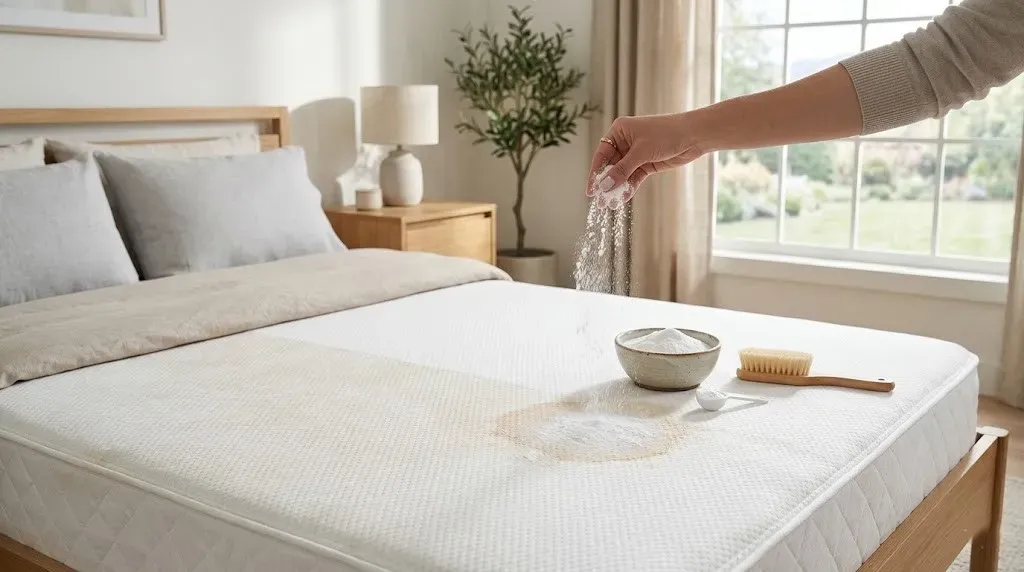
Pour it on thick. Really thick. This is where most people go wrong. A thin dusting barely absorbs anything. You want a proper, generous covering of the entire treated area, not just a light sprinkle. Think of it like spreading a layer of snow over the stain. Leave it overnight. At least 8 hours. The longer it sits, the more moisture and odour it draws out. Vacuum it all up in the morning.
That combination of a vinegar solution followed by an overnight baking soda treatment removes most fresh urine stains completely in one round.
Using Baking Soda for General Mattress Odours
Even without a specific accident, mattresses absorb sweat, body oils, and general bedroom smells over months and years. A baking soda treatment every three to six months keeps all of that in check.
Strip the bed completely. Pour baking soda over the entire surface of the mattress. The whole thing, not just one area. Leave it for a minimum of 8 hours. Ideally, do this in the morning so it can sit all day. Vacuum it all up in the evening and put fresh bedding straight on. Your mattress will smell noticeably fresher immediately. This one simple habit significantly extends the life and freshness of your mattress
The Baking Soda and Vinegar Paste Method
For more stubborn stains and older odours, dry baking soda alone is often not enough. The paste version is considerably more powerful, and it is worth knowing how to make it.
Mix equal parts baking soda and white vinegar in a large bowl. Do this over a sink because it fizzes up a lot when they combine. Wait for the reaction to settle into a thick paste. Spread it generously over the stained or smelly area, then use an old toothbrush to gently work it into the fabric so it gets below the surface rather than just sitting on top.
Leave it to dry completely. This can take several hours, depending on how much paste you applied. Once fully dry,y vacuum up every bit of it and let the mattress air for a while before doing your sniff test. Most people are genuinely surprised by how well this works on smells they had started to think were permanent.
What Baking Soda Cannot Fix Alone
Cat urine. Dog urine that has been in the mattress for a long time. Any smell that has returned repeatedly despite baking sodatrtreatments. In these situations, baking soda plays a supporting role, but you need an enzyme cleaner to do the main work.
Enzyme cleaners break down the uric acid crystals in pet urine at a molecular level. Baking soda absorbs and neutralises what the enzyme cleaner leaves behind. Use them together, and the result is far better than either one alone. Apply the enzyme cleaner first, let it dry, then apply the baking soda treatment afterwards.
For more on this combined approach, visit our guide to the best enzyme cleaner for mattress urine.
A Few Things Worth Knowing
Always vacuum baking soda up thoroughly after treatment. Residue left in the mattress can clump over time and affect the fabric. Use a vacuum with an upholstery attachment for best results.
If you have a memory foam mattress, be cautious with the vinegar and paste method,,s aexcessivech moisture can damage the foam. The dry baking soda method is completely safe for memory foam. Just apply, leave, and vacuum as usual.
For stubborn yellow stains that baking soda and vinegar have not fully cleared, hydrogen peroxide is the next step. See our guide on using hydrogen peroxide to clean a mattress for that approach.
According to Healthline, baking soda is a natural deodoriser that works by reacting chemically with acidic and basic odour molecules to neutralise them rather than simply masking them with fragrance. This is exactly why it works, so we primarily have acidic urine odours.
Related Guides
For removing urine stains from a mattress in full detail, visit our guide on how to get urine stains out of a mattress.
For everything covered in one place, visit: How to Get Urine Out of a Mattress: The Complete Guide".