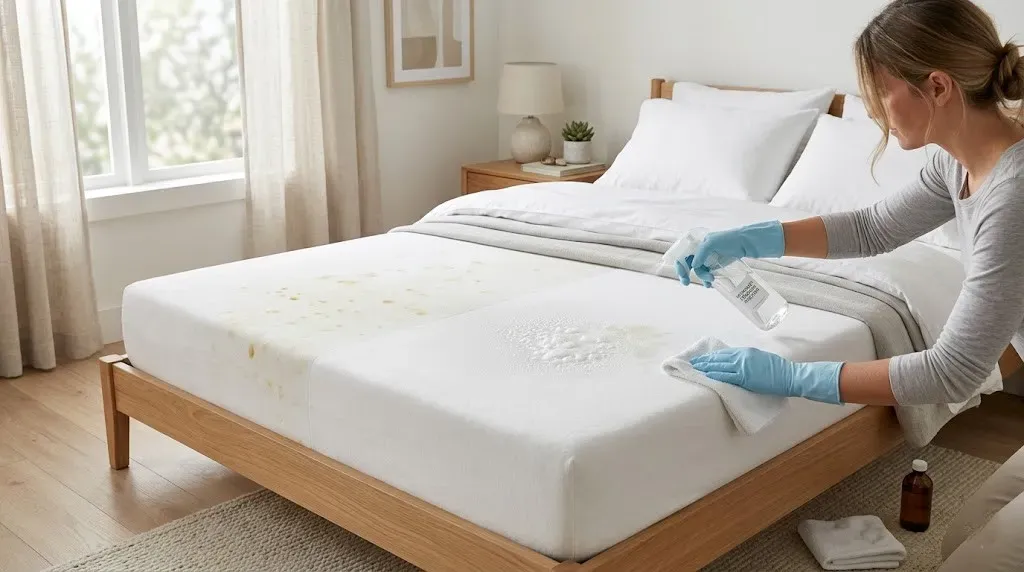
How to Use Hydrogen Peroxide to Clean a Mattress
Baking soda and vinegar get all the attention when it comes to mattress cleaning. But there is one product that quietly outperforms both of them on stubborn yellow urine stains. Hydrogen peroxide for mattress cleaning is genuinely one of the most effective options available, and most people have no idea how well it works or how to use it properly.
That is what this guide is about.
Why Hydrogen Peroxide Works So Well on Mattress Stains
Hydrogen peroxide is a mild bleaching agent. When you apply it to a yellow urine stain, it oxidises the pigment compounds, causing the discolouration. In simple terms, it breaks apart the molecules responsible for staining, making them colourless.
But it does more than address the stain. It also kills bacteria in urine residue and helps break down some odour-causing compounds. So it tackles the visible stain, the bacteria, and the smell all at once. This is why it works so well on old dried urine stains that vinegar and baking soda alone have not fully shifted.
Before You Start: Two Things You Need to Know
Hydrogen peroxide can lighten some mattress fabrics. Before applying it to a visible area, test a small amount on a hidden spot underneath a corner and leave it for 10 minutes. If there is no discolouration, you are good to go.
Also, never use more than 3% concentration of hydrogen peroxide on a mattress. This is the standard brown bottle from any pharmacy. Stronger concentrations are too harsh for mattress fabrics and can cause damage.
The Hydrogen Peroxide Mattress Cleaning Solution
You only need three things. Mix one cup of 3% hydrogen peroxide with three tablespoons of baking soda and a few drops of dish soap in a spray bottle. Stir gently. It will fizz slightly, and that is completely normal.
Spray this directly onto the urine stain. Cover the whole stained area properly. Now here is the part most people get wrong. Leave it completely alone. Do not blot it. Do not touch it. Let it air-dry completely on its own.
As it dries,s the baking soda forms a white powdery crust over the treated area. Once fully dry, vacuum up all the residue and check the stain. In most cases, es one application makes a dramatic difference. For a very old or severe stain, repeat the process two or three times. Each round gets you closer.
Where It Really Shines: Old Yellow Stains
This is where hydrogen peroxide earns its place. Old yellow urine stains that have been sitting for weeks or months are among the hardest to remove from a mattress. Vinegar helps, but often cannot fully lift the deep yellow discolouration that has had time to bond with the fabric.
Hydrogen peroxide goes further because it oxidises those pigment bonds, breaking them apart. Before applying the solution, lightly mist the old stain with cold water to rehydrate the dried urine crystals slightly. This helps the solution penetrate more effectively. Apply, leave to dry completely, and vacuum. Repeat as needed.
What About the Smell
Hydrogen peroxide significantly reduces odour, but it is not the most effective option for odour removal on its own. For a smell that persists after treatment, follow up by leaving a thick layer of dry baking soda on the mattress for 24 hours. Vacuum and check.
If the smell is still there after that, an enzyme cleaner is what you need next. Enzyme cleaners break down uric acid crystals at a molecular level and are the most effective for removing urine odour. For the full approach,h visit our guide on how to get urine smell out of a mattress.
A Word on Memory Foam
If you have a memory foam mattress, ss use this solution more sparingly than you would on a regular mattress. Memory foam absorbs liquid fast and dries slowly. Too much moisture can permanently damage the foam structure. Apply less, dry longer, and use a fan to help. For the full guide on memory foam cleaning, visit our article on how to get urine out of a memory foam mattress.
Is It Safe to Sleep on After Treatment
Yes. At 3% concentration, hydrogen peroxide naturally breaks down into water and oxygen as it dries, leaving no harmful residue. Just make sure the mattress is completely dry before putting sheets back on. Fully dry means no coolness or dampness when you press your palm firmly against the treated area.
According to Healthline, 3% hydrogen peroxide is widely used for household cleaning and minor disinfection and is considered safe when used correctly on appropriate surfaces. Sticking to 3% concentration and testing on a hidden area first are the two most important safety steps.
For Everything Else
Hydrogen peroxide works best as part of a complete cleaning approach. For fresh urine accidents, the vinegar-and-baking-soda method is often enough. Hydrogen peroxide earns its place for old stains, yellow discolouration, and as a disinfectant. For pet urine, combine it with an enzyme cleaner for the best result.
For a complete guide covering every mattress urine situation, visit: How to Get Urine Out of a Mattress: The Complete Guide.